RAR #281: Homeschooling High School with Rachel Kovac
How do we homeschool high school?
It’s *the* question, isn’t it?
A lot of us go into homeschooling ready and excited for the younger years. Then as high school approaches, things start to feel… a little more complicated. To say the least.
Navigating difficult subjects, transcripts, college applications, and alternatives to college if that isn’t a good fit for your child can be intimidating.
It’s no wonder that homeschooling high school is one of the most-asked topics here at RAR.
As many of you know, I have three kids who I homeschooled through high school who are now in college and beyond. My guest today is also an experienced homeschool mom who’s had two of her six children graduate high school and move on to college.
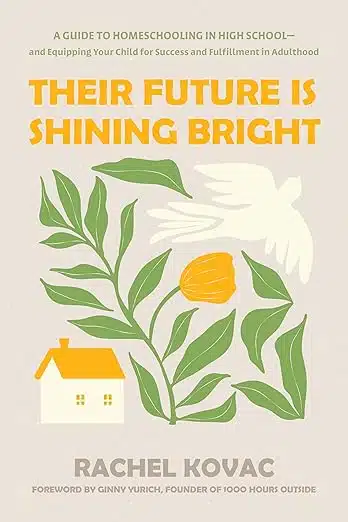
Rachel Kovac is a speaker, educator, and the author of the new book, Their Future is Shining Bright:A Guide to Homeschooling High School. I invited her to talk with me about the nitty gritty details of getting your kids through high school, as well as to share some big-picture encouragement as you face the challenges of the high school years.
In this episode, you’ll hear:
- Why the high school years feel so intimidating and what you can do to support a growth mindset for your teen
- How your role shifts as your kids enter high school (and why it’s something to look forward to!)
- Balancing doing less in your homeschool with keeping doors and paths open for your kids
Some links are affiliate links
Learn more about Rachel Kovac:
Books and Resources Mentioned in This Episode:
- RAR #209: What Worked? What Didn’t? Looking Back on Homeschooling with My 20-Year-Old Daughter
- RAR #233: Audrey Is Back, and She’s Answering Your Questions!
- RAR #276: Learning to Ask Good Questions (Audrey’s Back!)
- Rachel’s conversation with her kids

Sarah Mackenzie (00:15):
Welcome to The Read-Aloud Revival. This is the show that helps you make meaningful and lasting connections with your kids through books. I'm your host, Sarah Mackenzie. I'm the author of Teaching from Rest, Read-Aloud Family, and a growing collection of picture books, and today, I have a treat for you because we are going to talk about something so many of us are thinking about all the time, which is homeschooling high school. So many of you have written in and asked us questions about how I homeschooled high school. I have three kids who I homeschooled all the way through who are now in college or beyond, and I think so many of us are ready and excited to homeschool in the early years, in the younger years, but then as the kids grow, it feels like it gets complicated. We start thinking, "This really matters." We've got college transcripts we might be thinking of or what other options are if college isn't something that is a particularly good fit for some of our kids, and the pressure just rises a bit.
(01:14):
Well, my guest today knows all about these challenges. I've invited her here to talk about a few things, from big picture to nitty-gritty. Rachel Kovac is who's here today. She's a writer, a speaker. She's an educator and a homeschooling mom of six, two of whom have graduated. We're going to talk all about it. And she's also the author of a fabulous book I hope you've heard about by now. It's brand new called Their Future Is Shining Bright, and I think this is going to be a must read for anyone who's homeschooling high school. Rachel, welcome to the Read Aloud Revival.
Rachel Kovac (01:47):
Thank you so much for having me, Sarah. I'm so happy to be here. It's such an honor.
Sarah Mackenzie (01:51):
Well, you reminded me, Rachel, that we met several years ago at a conference, and it's so fun to reconnect. I feel like this is the question that is on everyone's minds even when they're homeschooling younger kids, because if they are looking toward the future, which we all are of course, homeschooling in high school can feel really overwhelming. First of all, maybe you could tell our listeners and viewers a little bit about your family.
Rachel Kovac (02:15):
Yeah. So I have six kids, two are in college. We were a read-aloud family, but it's really interesting because my eldest two kids are both in STEM.
Sarah Mackenzie (02:23):
That's so interesting. I have so many questions about this. I don't have any STEM kids yet.
Rachel Kovac (02:28):
Yeah, and it was really great. I just recorded an audio with them based on the audio you did with your eldest.
Sarah Mackenzie (02:33):
Awesome.
Rachel Kovac (02:34):
And they talked a lot about how amazing it was to be a read aloud family and how important it was, even though ultimately, they have decided to pursue careers in medicine. And so I just thought that was so cool. It was such a big part of my life. And I think even as a mom who loved the humanities, I didn't necessarily foresee that my kids would pursue science tracks, but they're each on their own paths and there are so many resources available to homeschoolers that we don't have to feel like it is all on us in terms of all of the teaching. We can guide them toward what's actually best for them. This is an example of something that wasn't natural to me. I'm not someone with a background in science, neither is my husband, but they found their passions.
(03:20):
And so then I have four kids still at home, ages 17 through eight years old. I have five daughters and one son, so yeah, everything's going great. My son just presented for the American College of Cardiology. His research was published.
Sarah Mackenzie (03:38):
That's so cool.
Rachel Kovac (03:39):
He did a research internship at Mayo Clinic, and sometimes people would ask, "Can you go to college if you're homeschooled?" And they just didn't understand that it's possible, and he's doing great. In fact, if anything, I think the homeschooling environment is a lot like college where you are doing classes but then also have free time. You have to learn how to manage your own learning, take accountability of your own learning, manage your time well, which I think can be a real issue for kids going into the college years. But also, there are so many options now that are non-college paths, so that's not the only way, and so my book is written for all students, whether they're pursuing a college path or non-college path.
Sarah Mackenzie (04:24):
I love this so much. There's a couple of things. One of the things that I think is just fabulous about this book, one of the many things, is one of the appendices where you have 265 career and certification paths that don't require a four-year college degree. You have ideas for if your kids are college bound. It's just that idea of seeing that whole person and being like, "What does God have for you? This will not be the same as what he has for your siblings." And this is why we're homeschooling in first place, I think, for so many of us, is because we want to meet our children as the individuals that they are.
Rachel Kovac (05:01):
Exactly.
Sarah Mackenzie (05:02):
Sometimes we can lose sight of that, I think, as our kids get older into high school because it feels ... I don't think we mean to. It just kind of happened. It feels that way, so let's start there. So why do you think high school tends to feel particularly intimidating for us as homeschooling parents?
Rachel Kovac (05:19):
Well, because I think the stakes are high, and I also feel like for my own journey, it was hard for me to get the right information. It might have been that I wasn't always looking in the right places, but I felt a little bit lost. So one of the things that was really beautiful about this book is I was able to connect with two people who were foundational in helping me and then who decided to share their expertise with the homeschooling community at large. One was someone named Dr. Abel Gonzalez. He was a first generation college graduate, and he felt like he didn't have accurate information. He runs dual enrollment for our city of 1.5 million and oversees five different programs, helping students navigate everything from apprenticeships, certification programs, the trades, to earning college credit in high school. Also, the college debt crisis is a real issue, so how can students save money? That was a big part of things too. He came beside us, we hosted something for our own community.
(06:19):
Then I had another person I connected with who is a college advisor. He typically charges thousands per student and he just wanted to help the homeschooling community understand how to handle college applications and that process, which has changed so much since I went to college. It can be a lot more complicated, depending on where your student wants to go.
Sarah Mackenzie (06:41):
Yeah, I think there's this sense as our kids get older that now it all really counts, and we might feel a little more comfortable experimenting or just seeing like, "Oh, we can't get too far off track when they're in first grade." That changes when your child's nearing the end of their at-home education experience, and we want to make sure that we're not ... I know for me, one of the things I was most worried about was I didn't want any of my choices to close doors for my kids that they would have wanted open, or that they didn't even know they wanted at the time, but I didn't want them to close doors that they might need open later, even if they didn't realize that when they were ... Even if they weren't ... For example, even if your kids weren't on a STEM track when they were 16, but then they decided they want to go to pre-med or whatever, that feels like something that we don't want them to be like, "Well, man, I can't do that because of the way my parents decided to homeschool me."
Rachel Kovac (07:32):
Exactly. And actually, I wrote a whole chapter on that about blending interest led learning with core academics.
Sarah Mackenzie (07:37):
Exactly.
Rachel Kovac (07:38):
Because I think if we still pursue core academics, then we really do leave a lot of doors open for our kids, and sometimes it can be really easy to label our kids. I write a story about how I was always told my entire life that I wasn't a math person. They said, "You are someone who should do English and you're the social butterfly and your sister's a math person." Well, it wasn't until college that I realized, I actually can do math, and there are a lot of people who have that same story. Now, I in motherhood found that I really loved creativity. I loved to sew, garden, I'm a photographer, but the other thing that I was told was that I wasn't creative because I wasn't good at drawing in art class.
(08:18):
And neuroscientists, when they look at the adolescent brain, know that it's particularly vulnerable or sensitive to things that are said about oneself in those years. Those experiences are stickier, so whether that's wounding in a romantic relationship, whether that's being ostracized by a friend group, or whether that's being told you're not a math person or you're not a creative person, those things can really take root and affect our identity. And so as homeschooling parents, how can we try to keep our kids living into a growth mindset where they believe all things are possible and that if they don't try, they won't know? If I wasn't required to take a math course in college, I would have never known that I actually really enjoy math.
Sarah Mackenzie (09:03):
I've been thinking about this with my own teenage years and I know that there are some soundtracks I have in my head from those years that I believed, being not a math person, which might be true in my case, but there are some other soundtracks from one of those years that I know aren't true, but that's so interesting that those in particular can become a part of our identity later on. Yeah. But it actually means that as homeschooling parents, then we have this tremendous opportunity to put soundtracks or to help our kids with their mindset, that growth mindset you're talking about, in a way that feeds them and nourishes them and propels them into their future. I love this so much.
Rachel Kovac (09:45):
Well, yeah, this is also true about the positive. Maybe you have a memory of being in high school and listening to your favorite song with your friends and the windows are rolled down or you're under the night sky or something like that, and it feels so alive. Well, that's because of that time in the brain too. It amplifies the good and the negative, and so there's potential for both sides.
Sarah Mackenzie (10:08):
As I think about homeschooling my oldest three, so my oldest three are now, my oldest daughter just graduated with a master's degree and then the other two, my second daughter, actually when this podcast airs, will be graduating as we speak basically with her art degree. And then I've got a son finishing up his economics degree, so they're all in college or beyond. But when I look back at their homeschooling experience in high school and I think about what I enjoyed the most, I think the thing that sticks out to me is something I didn't expect, I guess I should say, earlier when I was homeschooling, is that shift from direct teacher to ... It's not like I was standing at a chalkboard teaching, but just the role of teacher shifted somewhat into almost like a coach or an editor or a mentor. That just felt like it was happening in high school.
(11:02):
Then they all did dual enrollment for at least a little bit. They did various amounts of it at a local university, but I felt like especially when they started doing that, I was definitely just like the editor looking at their paper before they turned it in if they wanted me to. So it's a different role, so I really enjoyed that coming alongside my kid, that transition. I'm just curious for you what you've especially loved about homeschooling high school.
Rachel Kovac (11:27):
I think people are intimidated because I think, how am I going to teach science lab if they don't understand-
Sarah Mackenzie (11:31):
Totally. Yeah.
Rachel Kovac (11:32):
... that role of being a director? And it seems intimidating at first glance, but actually, like you're saying, in high school, there are even more resources than in the younger years for what your child can do for the things that they're interested in that you might not know. So like you're talking about with dual enrollment where there are more online courses if you decide to try that, there are co-ops, there are so many things that they can do. For myself, I have really loved maintaining that read aloud time. That's something that we consider to be sacred in our family, and we still do that one room schoolhouse kind of vibe every morning for two or three hours. I just recorded an audio with my kids and they said that that read aloud time was so key for our family connection. And it's so amazing because even though my kids are STEM majors at an SEC school, they are still so interested in reading.
(12:28):
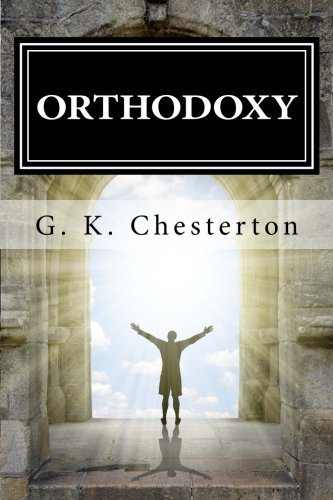
My daughter just finished Orthodoxy by Chesterton. My son is reading Augustine's Confessions. They have found the people that love to talk about books and they're involved in orgs where people love reading, and so that feels very holistic to me that you don't have to separate, you're a STEM person, you're a humanities.
Sarah Mackenzie (12:47):
Totally. Yeah. Yeah.
Rachel Kovac (12:48):
You can really hold it all, so I loved that time. I loved that we could grow together through literature, and now we have all of those ... We have our own shared vocabulary and that is so special. We were impacted from the very beginning by your work, and so reading aloud has been a part of what we've done from the very beginning. And I have one child who's dyslexic and she has struggled more with reading, but I listened to one of your first podcasts on this topic, and because we've done so much reading aloud, she has been able to, I don't know if you'd say consume, but have exposure to so much great literature because reading aloud is the way that she processes it best.
(13:34):
And it's been a hack for her in the high school years to listen to textbooks aloud if she has to do that for a chemistry class or something that we're outsourcing. We don't really use textbooks, but for her classes that are more traditional, she'll download them and listen. Or if she has books for a class for English at a high school co-op, she'll find it and listen to it audibly while she's reading along. And so it's just been a part of our family in so many ways and it's been so beautiful. I just can't recommend it enough.
Sarah Mackenzie (14:14):
I love this so much. I didn't tell you I was going to ask you this question, so I'm putting you on the spot and you're going to be like, "I can't remember a single one that we read." But are there any particular books that stand out to you as favorite read alouds?
Rachel Kovac (14:26):
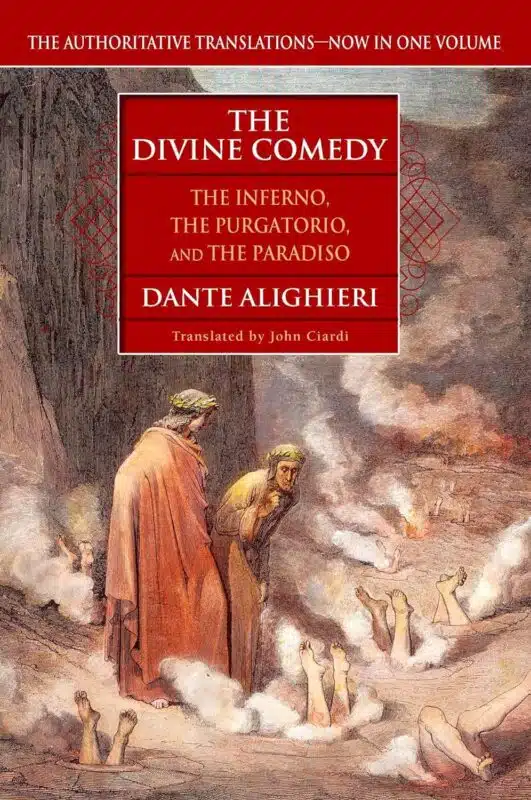
Following your example, I asked them, "What was the best thing that we did?" They loved reading the Divine Comedy, and we did it with 100 Days of Dante through Baylor, and then I also used some resources through Columbia University, they have a free class that's available online, and they felt like that was the most beautiful thing that we ever did. Then I asked, like you had asked, what was something that we did that was a slog that you maybe wouldn't recommend? And they said the only thing would be Moby Dick.
Sarah Mackenzie (15:00):
And that's quite a slog because it's so long.
Rachel Kovac (15:02):
My son is like, "Get this to anyone reading Moby Dick. Most of the information about the whales is not true." So not only are you going through having to listen to detail after detail about the fat and whatever.
Sarah Mackenzie (15:16):
They're inaccurate details.
Rachel Kovac (15:18):
But then you find out at the end that 80% of it is not even scientifically accurate.
Sarah Mackenzie (15:22):
Hilarious. Oh my gosh, so funny.
(15:29):
I wonder if you'd agree with this. I feel like when you talk to experienced homeschool moms, moms who've graduated some kids, and you say, "What do you wish you could tell your younger self or what would you tell a mom earlier in her homeschooling journey?" I feel like almost every time, they will say some version of, "Do less," which is also what I say when people ask me. "You're trying to do too much, do less."
(15:54):
First of all, I don't know if you would agree with that so I don't want to put words in your mouth, but if that's the case, then I just think one of the follow-up questions to that that we get a lot at Read A Lot Revival at least. I know in RER Premium, I have a program called Circle with Sarah, which is my homeschool mentoring program, and I'm constantly saying, "You're trying to do too much. Do less. You don't need to do as much as you think you do."This obstacle, the hardest obstacle to overcome is when those kids get into high school and it's like, "But how can I do less now?"
(16:23):
So I'm just wondering how you would answer that question or how would you advise a younger homeschooling mom who's going, "I think I'm probably trying to do too much. It feels like too much. We're constantly overwhelmed, but I don't know how to do that in high school. It all feels too important."
Rachel Kovac (16:40):
I think so much of that depends on the person to whom you're speaking ,and I think that ... Okay, for example, I told you both of my kids are in STEM paths. My son wants to be a doctor, my daughter wants to be a physician assistant. We didn't really do any formal science until eighth grade. We did a lot of spending time outdoors. So my aunts who are first generation homeschoolers said, "If your child can do math and if your child can read and think critically, they can do anything. The world will be their oyster if they're able to do those things," and I think that that is very true. So we didn't slog through science textbooks, and they have a genuine love of science, like someone has a love of art. They're like, "Chemistry is so beautiful." My daughter says science shows God is the divine logic of the universe. They're so moved by it. They see the artfulness of it, and we didn't do anything that was structured or formal until really eighth grade when they started going into co-ops.
(17:41):
But I do think in high school, sometimes it's important for kids to have access to those more traditional classes, depending on their path, because sometimes people aren't doing those things. And then we've seen homeschoolers that have had doors closed for them because they have been so free-spirited that it hasn't always worked out and then their child is disappointed.
Sarah Mackenzie (18:03):
Well, one of the things that came to mind as you were talking is that my daughter who is graduating from Savannah College of Art and Design this spring, she's getting a degree in sequential art, which is essentially graphic novels and comics and visual storytelling. People would ask me when she went off to art school, "Okay, so I have a kid who's really artistic. What classes? What did you enroll her in?" And I was like, "Yeah, so nothing actually." I think she did a lot of ... She was watching YouTube tutorials and she had artists she would follow as far as watching them talk about their process or tons of practice. When she got older into high school, her last couple of years, we found some online art school classes you could enroll in that were six or eight week classes, workshops online. But actually, if you ask her, she'll say the number one thing she had was time.
(18:51):
Actually, I should ask her now if that's still the case. I asked her a few years ago and she definitely said that, but I'll have to ask her if she still thinks that's the case now at the end of her post-secondary art education, but she just had a lot of time. And so often, I think we feel like we need to give our kids classes or professionals, and really, the thing that is the hardest commodity, I guess, to ... You can't create it, you can't make more of it and nobody has enough of it is actually time. That's the thing that is an advantage that we can give our kids that they wouldn't have otherwise, because just by nature of homeschooling, she had more time to explore, practice, and just play with and make mistakes with her art.
(19:33):
So I'm thinking in some ways, you probably don't have to do as many structured things as you think. Just by nature of homeschooling, you're giving them some opportunities with the time. In some ways, I felt like homeschooling high school wasn't that different than homeschooling younger. And something in our brain is like, "Oh, now it all matters." But I'm like, "Well, it all mattered, all the way along. You just weren't running out of runway so it didn't feel like it so much." There's something about coming to the end of our homeschooling runway where like, "Did I give you everything you need?" Oh no, no, of course you didn't. There's no possible way to do that. So in a lot of ways, I felt like homeschooling high school was the same thing as we had done before with more autonomy from the kids, less direct teaching, more conversations, and also that feeling that I had all three times with all three of my older kids that I was like at the end, "We forgot stuff. I hope you're ready."
(20:26):
And there's something about launching into the world that it reminds me a lot of teaching a kid to drive where, at least for all of my older kids, they were not as good of drivers when we were in the car with them. If I was sitting in the passenger seat while my child was learning how to drive, they could rely on me to be like, "Whoa, whoa, whoa, slow down, slow down. Do you see that thing up there, that car up there? Or watch that. Do you see that yellow light? So okay, you're going to need to get over to your right. There's nobody over here." I'm talking them through it.
(20:56):
But as soon as I got out of the car after they got their license, I felt like the first month or two after they got their license, they became a way better driver, and I think it's really just because I got out of the chair. Now they had to rely on themselves, and there's a lot of that that happens, I think, when they launch into the world too where they finish high school and we're like, "Man, I hope I didn't forget anything super crucial." And then they have to discover it in themselves, although none of that feels very tangible, probably very unsatisfying to the mom who's listening to this and is like, "Yeah, but how do I do less?"
Rachel Kovac (21:30):
Well, I think there are two myths that I found I was coming across when I was working on this book and what I would hear. So one of them was that homeschoolers cannot get into college, which is just not true at all.
Sarah Mackenzie (21:41):
It's just not true.
Rachel Kovac (21:42):
And so many people are homeschooling. In the state of Texas, we have twice as many homeschoolers as we do students in private school, which is just-
Sarah Mackenzie (21:48):
What?
Rachel Kovac (21:50):
Yes.
Sarah Mackenzie (21:50):
Really?
Rachel Kovac (21:51):
I just read this in the Houston Chronicle. It seems ... Yeah.
Sarah Mackenzie (21:54):
That is wild. Okay.
Rachel Kovac (21:55):
Yes. Okay. So it's becoming very well recognized. Almost every college has a path for homeschoolers in terms of how they apply. It's not strange anymore. We're familiar with it, right?
Sarah Mackenzie (22:09):
Yeah.
Rachel Kovac (22:09):
On the other hand, it might have just been the communities that I came out of. There was this myth that, oh, if your child just has interests and not a lot of learning, they're going to get lots of scholarships at Ivy League schools who are looking for out of the box students, and that's not really true either. So I think it's like if your child wants to go to an Ivy League, they say right on their website, "Homeschoolers are evaluated just like other kids and they're expected to take rigorous coursework," so I think we just have to avoid either extreme.
Sarah Mackenzie (22:39):
I like this.
Rachel Kovac (22:40):
And then I also think because some parents go in and say, "Oh, my kid can do all these amazing things," and I write a little bit about this in my book because we were a little bit impacted by that second myth. My son could play six instruments, he restored a vintage Land Rover. He had all these unique experiences, we had done out of the box classes, and then it didn't translate for the school he wanted to get into in terms of college.
Sarah Mackenzie (23:01):
I'm so glad you brought this up. This was something I had on my notes, because I felt like you're sharing about how ... You were really vulnerable in the book, I think, about how you wish that you had known more about the college acceptance process before your son went off to college. I just was really moved by sharing that whole experience of him not being able to attend his dream school, so yeah, tell us more. I didn't mean to interrupt you. Tell us more about that.
Rachel Kovac (23:25):
Oh, part of that was that even though we were doing really interesting things, colleges don't necessarily have a category for those kind of things. And so my daughter applied to that same school, and she had fewer extracurriculars but more traditional classes. She came in with 35 credits, some APs. She was given instantly $150,000 in scholarships.
Sarah Mackenzie (23:46):
Interesting.
Rachel Kovac (23:47):
And that was just a starting point. If she would have accepted, she would have received even more scholarships. This was for over four years, 150,000 over four years, but she got into her top programs when we made some changes. My son faced a lot of disappointments because of misinformation that he had heard when scholarships didn't come through and things like that, because we were told, "Oh, Harvard is scouting out homeschoolers." And you can see that they have this beautiful education, and-
Sarah Mackenzie (24:18):
Well, there is that kind of thing about like, "Oh, well, they're just looking for interesting students and your kids are interesting because they're homeschooled." I've heard that a lot, and I don't think that's true.
Rachel Kovac (24:26):
I can only share our story, and there are colleges that are looking for students that are off the beaten path, but more traditional schools tend to be more traditional. Do you know what I mean?
Sarah Mackenzie (24:38):
Yes.
Rachel Kovac (24:39):
And so I really encourage parents to call the school that your child is interested in because that's how you can get the most accurate information, rather than going based upon hearsay. And we had heard some things about dual enrollment, like, "A college is a business. They don't want any dual enrollment. They want your child to be there all four years, so don't do any dual enrollment."
Sarah Mackenzie (25:00):
Oh, interesting.
Rachel Kovac (25:01):
Or dual enrollment, it's better to bring in interesting classes than to do dual enrollment, because then your child is unique and out of the box. And that just didn't translate, but my son wasn't applying to out of the box schools.
Sarah Mackenzie (25:15):
Right, right, right. One of the dual enrollment classes that Alison, my 22-year-old, I actually required her to take was math, because I was like, "You've got to do it now, because if you don't, you're going to forget all your math, all this higher level math, so you should do it as dual enrollment and you get your math requirement out of the way." Well, it turns out she went to Savannah College of Art Design which does not require math for a bachelor's degree. So she still jokes about how mom made me take math as an elective, which seems especially cruel.
Rachel Kovac (25:47):
That is so funny.
Sarah Mackenzie (25:47):
Yeah, it's pretty funny, but yeah.
Rachel Kovac (25:49):
That's such a good point too, because my son says, "I wish I would've done English." He wishes he would've gone in with 15 credits or so, because also, he was deprioritized in enrollment because 35% of kids come in with some form of dual enrollment to college for kids who are at college now.
Sarah Mackenzie (26:04):
Okay, yeah.
Rachel Kovac (26:04):
And dual enrollment in general is skyrocketing. So in the early 2000s, 300,000 students had some form of dual enrollment. By 2021, it was 1.5 million, and the most recent statistic is 2.8 million students come in with some form of dual enrollment, and it's not just for intellectually precocious kids. It might be for kids who are wanting to have practical skills as they go into the workforce, so they might graduate with an associate's degree or a trade degree or a certification and then enter the workforce directly. And so I think we're really in a revolution in terms of what education will look like in the high school years, and having it be more individualized toward each unique path.
Sarah Mackenzie (26:52):
There's this section that you wrote that really stuck out to me, so I'm just going to read it back to you, your own words back to you and see.
(26:58):
"We can sometimes view work as duty, a necessity, or even a burden, or perhaps we've absorbed a belief that in order for our work to matter, it must stand out, accomplish something remarkable or gain recognition. But the irony is that the seemingly ordinary is often exactly what the world needs most. This isn't just a comforting thought. It's how God ordered the world from the beginning, and so our kids are free, free from the weight of comparison, free from chasing someone else's definition of success, free to choose good work that allows them to serve, grow, create and contribute, joining in the way God and his goodness cares for all he has made."
(27:41):
Because I just read this, I can hear the fullness of what you're sharing, which is yes, your kids were made for something and their interests and passions and all those things, we want to pay attention to those and make sure they have the tools they need. And you would wish you had a little different information so that you could have helped your son set up differently when he was applying for a school. And also, our kids are free and the world is wide, and so much of what I felt like when I was reading your book was the ordinary parts of your homeschool were also the parts that fed ... It's like remembering that they're whole persons as well, so we're giving them tools for their future. But what I'm hearing is we're not supposed to walk the path for them. We get to walk next to them while they figure out what their path is kind of a situation.
Rachel Kovac (28:30):
Yeah. And I think sometimes, it's hard being a homeschool parent, but you know this having graduated three, it's worth it. And sometimes, it does require a lot of us. Being a mom of young children, I was a doula, I was a lactation counselor, I loved the baby days, but it also required a lot of me and it's also worth it. So just because something is hard doesn't mean that we necessarily need to shirk back, because now when my kids, now that they're adults, they say, "Mom, it was so amazing to have those memories." And we're at the stage where now, my son always says, "It will either be a good time or a good story."
Sarah Mackenzie (29:07):
That's so great. Yeah, I love that.
Rachel Kovac (29:09):
And now they're like, "Wasn't that so weird? How did that actually happen?" Just these various things like road trips or things that-
Sarah Mackenzie (29:18):
It's a really helpful thing to remember when something bad happens. Well, it's not a good time, so it's going to make a good story at some point, you know?
Rachel Kovac (29:24):
Exactly. And this last spring break, we just laughed so much about all the things that were not a great time but were a really good story. And so I think just encouraging people to keep going, to keep pursuing that which they see as good and beautiful and true, and knowing that that pays off.
Sarah Mackenzie (29:44):
Yes, I love this.
(29:49):
Okay. So one of the other things you bring up in here that I think is super important and is very relevant to a lot of viewers and listeners who are thinking about this for their own kids is the role of community. You have a whole section, a whole chapter in here called It is No Good to be Alone or something. Hold on. Yeah, It's Not Good to be Alone. I thought I remembered that right. And as homeschoolers, we're often looking for community or trying to tap into the community, find the right community for our kids as we go, but in high school, it feels crucial, and it is crucial actually for them to be a part of a community. So I just wonder if you can share some different ways that your family or that you've heard of other families like finding community in the high school years for listeners or viewers who are like, "Yeah, I'm not sure what that's going to look like or I wonder what that could look like."
Rachel Kovac (30:33):
Yeah. I would definitely also recommend the podcast you did with your daughter because you talked about this from your perspective and from her perspective. That was really beautiful too. It can take more effort. It depends on how many resources that you have in your community, but now more than ever, homeschoolers have so many resources available to them. So I think there are several ways to look at this. One is kids can do things like co-ops. So one of the questions that my kids got most from adults was, "What about the high school experience?" And particularly, "What about prom?"
Sarah Mackenzie (31:06):
I know. I don't know why everybody's like, "What about prom?" It's so funny to me, but yes. [inaudible 00:31:11]
Rachel Kovac (31:10):
Okay. Now, homeschooling co-ops, they do those kind of things.
Sarah Mackenzie (31:14):
Yeah, they sure do.
Rachel Kovac (31:15):
They have their own prom. My daughter was just at prom. Other daughter was like, "I don't want to do the prom thing," but my one daughter did, and so she got to have the magical night and it was very special. There are co-ops. There are a lot of those traditional high school milestones that you can opt into if you would like. Also, there's dual enrollment where kids can meet other friends, and then if you're involved in community organizations, my kids are in the youth orchestra, they sing in our city's Children's Chorus, and they're also involved in church, and so there are a lot of opportunities to meet peers in those places. But I think there are two things that we can think through. One is that never in human history have kids only been surrounded by peers for so much of the day, and so it's okay if they're not always surrounded by peers.
Sarah Mackenzie (32:06):
And that's actually never a thing that gets replicated again outside of that age. Never again in your adult life are you only surrounded by people your exact same age.
Rachel Kovac (32:16):
Exactly. So while I'm podcasting with you right now, my daughters are over with my neighbor who's in her 60s, who's also taking care of her granddaughter who is two years old, and they're in this multi-generational environment, helping her care for a baby, learning from her as a woman who has a lot of life experience. That meets a need too. My son was involved with folks at church who were in their 20s. He would go biking with our neighbor who was 60 and they'd go on a 13-mile bike ride, so we can think outside of the box, and it depends on if your child is an introvert or extrovert. Some introverted kids may only want to have a few close friends and those connections will be quieter and they don't have to be surrounded by a large group of people all the time. That's not failing.
(33:06):
And so going into it thinking a little outside of the box, thinking creatively of what this could look like for each of our children, and some of our kids will want more of that. If they're extroverted, they might want more social time with their peers, but it's really great to be able to give them the opportunity to not only develop relationships with folks their own age, but also folks who are older and younger.
Sarah Mackenzie (33:27):
Yeah. It always has struck me, I come from a family of teachers, and my mom would talk about how she was always trying to make her classroom feel more like a home. She'd put beanbags and a sofa and a lamp and a reading nook, and here I was at home trying to make my home more like a school because I felt like it needed to be. That was in the early days, but as they get older, I think we just start realizing, "Oh, this is actually mimicking real life," and it's giving them so many experiences that they're going to have, like a taste of interacting with people who are different ages, different personalities, different-
Rachel Kovac (33:58):
Well, and like your daughter said in the podcast you did, my daughter was saying, "It was so special to have my days with my little baby sister and read books with her on my chest." And now that she's away a college three hours away, my eight-year-old cries because she misses her so much. So they also can have relationships within our own family too, and I'm still really close. I love what you say because I feel this so much. I think having adult kids has been such an unexpected joy, and you have said the same thing. People were so negative. I heard a lot of negative things about it, and I had a lot of fear sending my son off to college, and it's a transition and there can be some grief in that too. I'm not diminishing that that can be true, but it's amazing having adult kids. It's so exciting.
Sarah Mackenzie (34:44):
Yeah. It's such a special joy. It's really interesting too because when I say that, it's not like my adult kids are always making decisions that I'm really excited about either. It's not like, "Oh, well, that's because your kids have come out really great." Well, yes, and they're not always making choices that I'm like, "That's a good idea or that's a good choice." I just think it's different. There's a different grace that we ... I don't know, there's so much fear around our kids leaving the nest, getting older, becoming unruly teens and then young adults, and I just think it is absolutely delightful in ways that we cannot even imagine when they're toddlers. It's so great. Yeah, I love it so much.
Rachel Kovac (35:28):
It's so fun. Do you guys have a family group text with your kids?
Sarah Mackenzie (35:30):
Oh yes, yes.
Rachel Kovac (35:31):
It's so fun.
Sarah Mackenzie (35:31):
It's so fun.
Rachel Kovac (35:34):
They call me and they're talking through, and yeah, the stakes are high, like talking through, "I don't know about this relationship," and what if it's someone that they're going to marry? That's a really big deal, but it's still a joy to walk beside them and have the conversations and the closeness that we built through all the years homeschooling
Sarah Mackenzie (35:51):
Yeah, and the connections, that is the part. No matter what you do or don't do, this is what I think I would tell my younger self, at least coming into the high school years for homeschooling. Yeah, do your research, see what you can figure out, pay attention to the child in front of you so you can be like, "What do you need? What would best serve you as you're launching into this life that God has uniquely envisioned and created for you?"
(36:17):
And also, your relationships with your kids matter more than absolutely anything, and so anything you do or don't do, and there were things that I dropped the ball on as far as we just never taught that subject. I forgot that we needed to do it, or didn't forget, but I had too much ... I was very overwhelmed. Or gosh, sure, I have regrets and things I'm like, "Oh, I wish I had done that differently or I wish I had done this differently," but for the most part, the things that matter most are the relationships with your kids, and so it's worth every second, every second. I loved it so much.
Rachel Kovac (36:52):
Well, and I think when you have that relationship in place, I've been really grateful to have been met in a lot of grace. There were years when we had a big family, we didn't do as much, and my kids can see that we learned to learn independently, to take responsibility. My son one time said, "You know, kids got to learn to pull their own weight."
Sarah Mackenzie (37:12):
All three of my adult kids will come home and be like, "Are these all the chores? This is all that they're responsible for? Are you kidding? Do you remember how much work you had us doing?" I'm like, "I know, but you know?"
Rachel Kovac (37:24):
So funny. My daughter and I were just laughing so much when my son said that about my younger. "They got to learn how to pull their own weight." I'm like, they're still kids.
Sarah Mackenzie (37:31):
Oh, funny. I love it. Oh my gosh.
Rachel Kovac (37:34):
It's so funny, but they think actually, the things that they did, they helped me more, and they're like, "That helped me become more responsible." It's not like we were asking them to parent or anything like that, but their job wasn't only to be a student, which is how a lot of parents might in a traditional school setting because they're so busy going to school all day and then extracurriculars in the evening. And even when things didn't exactly work out with my son in terms of how we envisioned it to be, he's so happy to be at the school he's at now, and he's like, "Mom, it's all God's providence. This is how it was meant to play out." And they haven't held it against me, but I think that's because we have that relationship in place, and so I try to see them from a spirit of grace and they've given me that grace back in spades.
Sarah Mackenzie (38:22):
Yes, totally. There have been a few times too where my adult kids will say, "Why didn't you XYZ?" And I think because we have such a good relationship too, because relationships were such an important piece, I can go like, "You know what? I wish I had. I wish I had done that differently. If I was doing that again now, I would do it differently and here's how." And it feels like a repair in a way that there's grace where they're like, "I'm so glad ..." Or they can see the beauty in things that they might not have appreciated before, but also even in the things that I think they may be disappointed in, there's also grace there and repair in our relationship there where it's like, yeah, I totally didn't get it all perfectly, and I actually think I wish I had done that thing differently.
(39:10):
One of the things that I also think is really interesting is that when my 22-year-old, who's at art school, when she first went off to college, she said, "Gosh, I cannot believe how hard it is for so many other kids who are here to manage their own schoolwork." Now, this is not a kid who I would've actually felt was doing a particularly great job managing her own schoolwork, so I was like, "Really?" And then she had commented about how, "I guess I just managed my own schedule a lot more than they did." I was thinking, this is not because I sat down to teach her. It's not because I was like, "I'm going to give my child the executive function skills to be able to manage her time." What happened is I had a thousand babies and I did not have time to manage her schedule, and so I gave her a list and she had to figure it out.
(40:00):
And at the time, back when I was doing it, I would've said, "This is something I'm worried that I'm a hindrance for my child, that I'm not able to give her the amount of time and energy that I feel like she should have." So I would've thought it was like, this is one of the things that my kid is having to ... It's like a setback because we come from a big family where there are so many little babies, and I just can't give her all my attention. That ended up being something that helped her in the end.
(40:25):
So I think even the things that we feel like are shortcomings or we wouldn't choose, like I wouldn't choose for her to feel like she had to manage her own schoolwork at 12 because I was so overwhelmed, I couldn't help her with it, it ended up being a blessing and I think there's something to be gained from it. I don't know, I just think that can be a really hopeful thing to hold onto and remember as well.
Rachel Kovac (40:45):
My kids have said exactly the same thing, that so many kids really struggle with time management, and actually, sometimes they might fail out or have to change majors because they simply haven't really been taught how to manage their time or to have the practical skills of knowing how to cook a meal for themselves or pick up after themselves, because their parents did those things for them wanting to be like a loving mom. But then ultimately, my kids have felt like they went into the adult years really well-equipped and knowing how to manage their own schedule, having those practical skills.
(41:16):
But I think you do make a really great point, and my friend Leah Boden talks about this too, she wrote Modern Miss Mason, that it's important to acknowledge when we get things wrong or if we've hurt our kids. And I think you're right, that repair step too to say like, "Hey," I have said to my son, "I'm really sorry that I didn't have the information. I was trying to do my best, and yet I didn't have ... And I know it caused you pain and made things more stressful for you," and I've been received in grace. But I think it's important for us as we have adult kids, because it doesn't mean you're not a good parent if you've made a mistake. Everyone makes mistakes, and it's good for our kids.
Sarah Mackenzie (41:56):
And even if your child doesn't receive you in grace, even if they're mad about it.
Rachel Kovac (42:00):
Which can happen sometimes, but still, it's the right thing to do to say ... Even if we feel I was just doing the best at the time or whatever, and we probably were, right?
Sarah Mackenzie (42:10):
That's right.
Rachel Kovac (42:11):
But we can still say, "I'm sorry that that hurt you."
Sarah Mackenzie (42:14):
Yeah, totally.
Rachel Kovac (42:16):
It doesn't diminish who we are, and that's where we have our identity placed in Christ, and then we need grace and we can ask for it. And so I think as we raise adult kids, that's important too.
Sarah Mackenzie (42:31):
Me too. One of the things is you were talking about making a meal. I also had experiences where my oldest daughter was such an oldest daughter that when she left, I was like, "I haven't taught the other kids how to do ..." She went off to college and I realized, my other older kids don't know how to do anything in the kitchen, nothing. I was so dependent on Audrey, poor thing. So then I send off the other kids and I'm like, "I legit don't know if these kids know how to make a grilled cheese sandwich." I guess that was one of my failed spots. You know what? They can all do it now, and Allison came home from college last summer and she made this beautiful pasta dish and I was like, "Huh, who taught you how to do this? It wasn't me. I could guarantee that." But she figured it out.
Rachel Kovac (43:19):
My son is such a traditional firstborn too, and so when he left for college, you think it's going to get easier having fewer kids at home, and I'm like-
Sarah Mackenzie (43:26):
Gosh, no. I know.
Rachel Kovac (43:27):
"This is so hard. I am horrible at managing this household." When he left, I'm like, oh my gosh, I need to learn some management skills.
Sarah Mackenzie (43:34):
I was like, "Oh, it became real clear who was running this place, and it ain't me."
(43:42):
I do remember one time, my son, he had to have been ... Okay, let me think. He must have been 16 at this point. Comes down, he's like, "Man, there's just nothing good to eat around here without Audrey." And I was like, "Yeah," because she'd bake all the time. I'm not going to bake, so I was like, "Yeah." And then he's like, "Is there like a Lego kit for cookies?" And my nine-year-old was like, "Like a box mix? Is this what you're talking about?" He's like, "That's a thing. Yes, that's what I need." And so Clara is like, "Let me show you how to make a boxed brownie mix." And so I have pictures of them. We can put them in the show notes. I'll find them and we'll put them in the show notes. I have pictures of Clara teaching Drew how to make a box mix.
Rachel Kovac (44:25):
Yes, you have good news for him. There is.
Sarah Mackenzie (44:28):
There is a Lego kit for baking.
Rachel Kovac (44:31):
Some of those brownie mixes are amazing too.
Sarah Mackenzie (44:33):
It's true. Yes, I love this.
(44:38):
Well, Rachel, I feel like you and I could talk the entire day or a week. I think we could just sit here and talk so much, I love it. I think we better wrap up our time, but I wanted to tell our listeners and viewers a couple of things. The podcast that we've mentioned a few times of me talking with my daughter, Audrey, there are a couple of those actually. We'll put those in the show notes, you can go listen to them. The show notes are at readaloudrevival.com/281, because this is episode 281. We'll also link to Rachel's conversation with her kids. These are the kind of conversations I really would have loved to listen to when I was at a younger stage in my homeschooling, is to listen to moms and their grown kids having candid conversations about what they wish they had done more of and less of and what they shouldn't have worried about and what they should have, especially when your kids feel free to tell you the truth.
Rachel Kovac (45:29):
It's true.
Sarah Mackenzie (45:32):
And then you guys, if you were thinking about homeschooling high school, you want this book. It is called Their Future is Shining Bright. It's out now. We'll put it in the show notes. Get your hands on it. I think it'll bless you. Rachel, you've certainly blessed all of us today. Thanks so much for coming on the show.
Rachel Kovac (45:46):
Oh, thanks so much for having me, Sarah. You're such a delight.
Sarah Mackenzie (45:52):
All right, let's go listen to hear what the kids are loving reading lately.
(45:59):
What's your name?
Ashley (45:59):
Ashley, and I live in Texas.
Sarah Mackenzie (46:05):
How old are you?
Ashley (46:07):
Four.
Sarah Mackenzie (46:07):
No, you're not four. How old are you?
Ashley (46:08):
I'm 16.
Sarah Mackenzie (46:11):
You're not 16. You're three?
Ashley (46:12):
[inaudible 00:46:14].
Sarah Mackenzie (46:13):
Yeah. And what's your favorite book?
Ashley (46:18):
Toad and Frog and ...
Sarah Mackenzie (46:20):
Toed and Frog, and what else?
Ashley (46:22):
Yeah, Anna.
Sarah Mackenzie (46:25):
Why do you like The Very Hungry Caterpillar?
Ashley (46:30):
It's fun.
Sarah Mackenzie (46:30):
Because it's fun?
Ashley (46:30):
Yeah.
Cora (46:32):
Hi, my name is Cora and I'm nine years old and I live in Ames, Iowa, and I like Where the Mountain Meets the Moon because there's adventure, because there's mysteries you always have to figure out.
Everett (46:44):
My name is Abert. I live in Iowa and I'm 10 years old. I like the Red Wall Series because there's adventures and there's battles and you have to solve riddles.
Leo (46:56):
I'm Leo. I live in Iowa and I'm 7 years old. I like the Harry Potter books, and my dad [inaudible 00:47:03] with each one of them, and they're all super good, and I like the witches and wizards and the stories.
Dewami (47:18):
Hi, Almost Time [inaudible 00:47:13]. And my name, Dewami, and we're making maple syrup right now.
Sarah Mackenzie (47:26):
And is that why you like Almost Time? Yeah, because they make maple syrup too.
Dewami (47:30):
Yes.
Alba (47:32):
Hi, my name is Alba. I'm nine years old, I live in Winnie, Texas, and my favorite book is The Magnet Tree House. And why I like it is because whatever it's about and someone asks them to do something and they think that it's hard, they will never give up on it.
Sarah Mackenzie (47:53):
Thank you so much, kids. I think that's it for now. We'll be back in another couple of weeks with a new episode. In the meantime, you know what to do. Go make meaningful and lasting connections with your kids through books.