Audrey Menck (00:00):
It’s really easy to just reach for all the answers that are right at our fingertips. And that is a huge gift, but I also think it’s one that we should wield wisely. I remember having all sorts of questions as a child. Listeners, you probably do too, and you remember the funny answers that you would come up with. I think there’s something powerful about that, about simply just letting our minds consider what the answers could be.
Sarah Mackenzie (00:25):
Well, hello, hello. Welcome to the Read-Aloud Revival podcast. I’m your host, Sarah Mackenzie. And today my guest is a listener favorite and a favorite of mine, too, in fact. In episode 209 of The Read-Aloud Revival, my oldest daughter, Audrey, came onto the podcast to share all about what it was like growing up in our bustling homeschooling family. She’s had a few adventures since the last time she was on, and I’m so delighted to welcome her back to the show to share about what she’s been up to, talk through some of the questions you asked, you send in and ask for her quite often, like what kinds of things shaped Audrey as a writer, and how does family life continue to influence her life? And we also want to talk about the role of reading in her own life in this season, postgraduate life, which is a little spoiler.
(01:18):
Hello, hello, my dear. Thanks for joining me on the show again.
Audrey Menck (01:21):
Thanks so much for having me. It’s lovely to be back.
Sarah Mackenzie (01:25):
Give us a life update. What have you been up to lately?
Audrey Menck (01:29):
Yes. I’ve been up to a few things since I was last on the show. I just got back last week, I think, from graduating at the University of St. Andrews with my master’s degree in theology and the arts. It was such a delight to return back to Scotland. I had wrapped up the program in the summer, but we graduate in December. Got to return to my Scottish stomping grounds and got to go to all of my favorite little places and see friends. And you got to come along, too, which was just fabulous. We had a great girls’ week traipsing through bookshops and drinking tea and wandering the beach. It was wonderful.
Sarah Mackenzie (02:10):
It was the stuff dreams are made of. I know every mom listening to this right now is super jealous because we all like, “This sounds amazing.” It really was amazing. It’s also extra special just to spend time with one child. It’s a whole week where you and I got to just be together, and then for that to happen to be in the UK, I mean, gosh, twist my arm. It was so fun. It was really fun. I think some particular highlights for me were. One was just seeing you in the place you had lived that last year. Your favorite places. You’d tell stories when you were walking down the street like, “This is where we go when we go study.” Anyway, meeting the people that have been such a huge part of your life for that year you were studying. All your friends.
(02:59):
Baby Henry, not that I’m playing favorites, but maybe I had a favorite. Possible. Let’s see. Then we went to Edinburgh for a couple of days, and we watched The Snow Queen at the Scottish Ballet which was storytelling magic. It was so great. And then we also went to the Edinburgh Zoo, which was funny. When we walked in, the person checking us in said, “The Edinburgh Zoo is built on the side of a hill, so you’ll be walking uphill,” which I think was an understatement. It sort of felt like climbing a mountain. I remember at one point being like, “I’m not taking one more step up. We’re done going up.” But fortunately, I don’t know if they did this on accident or on purpose, but the giraffe exhibit is at the very top, and it is worth it to get all the way up to the top because that was so fun. It did feel like scaling a mountain, but it was still worth it.
Audrey Menck (03:50):
They’re really the prize at the very top.
Sarah Mackenzie (03:52):
They are absolutely the prize at the top. We hung out there for a while, not just because we were tired.
Audrey Menck (03:58):
We just had a little chat with the giraffes. It was great.
Sarah Mackenzie (04:01):
We did.
Audrey Menck (04:03):
Now, I’m moved back to the Pacific Northwest. I’m stepping into a bigger role here at Read-Aloud Revival as the creative director which means you’ll be seeing a little bit more of me here and there, which is exciting. And in addition to that, I’m just stepping into new volunteering opportunities and making more time to write some non-academic work and just jump back into life with community here. After the intensity of grad school, I am definitely looking forward for just some time to write and meander and think through some things.
Sarah Mackenzie (04:33):
Read what you want to read. Things like that.
Audrey Menck (04:37):
Yes. I’m hoping to in the new year kind of start a weekly newsletter that’s a bit more regular, and we can link to that in the show notes as well, and then submit some articles and essays to places too.
Sarah Mackenzie (04:49):
Through our email at Read-Aloud Revival, we get a lot of questions. I get a lot of questions specifically about homeschooling or connecting with each of you kids or different aspects of that and book recommendations. But actually a fair number of questions come in directed at you, Audrey. And quite a few questions, especially with writing. I think because you’ve done so much writing, and you continue to do writing, and it’s clear when anyone’s reading your writing, which yes, we’ll definitely put your newsletter in the show notes. It’s clear when you’re reading it that the love for the written word and for the world, for life, is really apparent.
(05:24):
Anyway, I know, as our listeners can guess, we did a lot of reading aloud in our house while you were growing up. And I just wonder if you had any insight into how reading aloud in particular may have influenced that writing piece.
Audrey Menck (05:42):
I think a few things come to mind. And the first two are poetry and audiobooks and, with that, reading aloud because hearing the written word spoken aloud has such an impact on the way that we engage with language and learn to recognize remarkable writing because we hear it through the ear first.
(06:04):
Malcolm Guite has this great line where he says, “Poetry is meant for pleasure,” because he wants us to read it aloud. And I love that, that it comes through the ear first, and it’s in the hearing of it. Even as you’re writing, too, I find that it’s the sound of the words that makes it musical, that makes it magical in a certain way.
Sarah Mackenzie (06:26):
One of my favorite middle-grade authors will say … I love it when she says this. She’ll say that she thinks listening to books read aloud is actually more important for her skill as a writer than even reading words off a page with her eyes because it’s hearing the actual cadence and rhythm and sound of the words that’s really useful.
Audrey Menck (06:48):
I think also just having the time and space to write. In the world, we just don’t have that space for boredom anymore. And it’s just so easy to fill our lives with noise, even good noise. I think carving out that space to be bored and wander outside in the sunshine and be alone with your own imagination … I think those things were what would take me scribbling in a notebook at 12 years old because I had this space to just hear my own thoughts. I think it’s twofold, right? It’s hearing the thoughts of others, of good writers, and then also allowing that to propel you into having your own thoughts too.
(07:24):
So much of learning to write is, of course writing, but as most writers would say, it’s also living in order to capture the world well. And even in a fantastical or fictional sense, you have to truly taste it for yourself and know what it is you’re talking about. We do that through seeing new places and encountering people in all walks of life. And I think a lot of my love for travel and life abroad has really stemmed from reading good stories and those experiences that then propelled my writing. It comes full circle in a way.
Sarah Mackenzie (07:58):
It makes sense that you’ve got to live and see things and experience the world to be able to write about them. Otherwise, we’re just writing about, I don’t know, nothing because you got to have life to write about.
(08:08):
One of the things that strikes me about when we interview authors at RAR Premium for family book clubs, and all of these picture-book authors and middle-grade authors come on and chat with us so often, they say that one of the key things for them is to bring a notebook around out into their life, out as they’re doing things in the world. And I think it’s tempting to be like, “I just need to write more. My kids just need to write more to get good at writing.” But I think this is sort of an invitation. It’s an invitation for us as families to realize that so much learning and so much writing, in fact, happens away from the page. Your kids are getting so much fodder for … They’re making connections in the creative life as they’re reading and also as they’re just experiencing the world. In order to have things to write about, we have to get away from our writing for a minute.
Audrey Menck (09:00):
Absolutely. And I also want to emphasize, too, especially for families, that you don’t have to go all the way across the world to develop and grow the scope of your imagination. It can happen at your local park or soup kitchen and church. It can happen in the grocery store. We really didn’t have the ability to travel much when I was young, but I do really think it was stepping out into our community that is what sparks that intrigue and delight in the world which has then propelled me to make my home in lots of different places.
Sarah Mackenzie (09:31):
That 100%. I love this so much. And I also think it’s really encouraging, especially to families who may be … Because of their current circumstances or, “I can’t travel the world or give my kids amazing experiences out in the world.” Like you just said, Audrey, we didn’t actually travel much at all. I mean, we didn’t travel at all actually when you were young young. And it wasn’t until you were a teenager that we even started traveling very much, even started traveling. Most of your travels have actually happened since you’ve graduated on your own as an adult. It wasn’t like I had to give you those worldwide adventures as much as I would have loved to. That just wasn’t in the cards for us.
(10:10):
Also, if someone’s listening and has … You’re in a stage where you have babies and toddlers, or there’s medical issues or just a lot of responsibilities. If something is keeping you from going out … So much of Audrey’s childhood actually did happen within the walls of our home. I think it’s more about recognizing that a lot of the foundations for writing, the experiences, the connecting, the boredom, like you said, the time to be able to connect ideas or think through and reflect on things doesn’t require that you overhaul everything. It can actually happen in a very ordinary homeschool.
(10:42):
After I went to your graduation, Audrey, I wrote an email updating the email subscribers. Once a month, I do something called From Sarah’s Desk, and it is an email where I’m just kind of reflecting on homeschooling and what has worked and what hasn’t, what I wish I could have tell myself if I could go back earlier in my mothering days and just encourage myself in my mothering. Listeners, if you want to get that email too, you can just subscribe to my email list which you can do at readaloudrevival.com/subscribe. That goes out free once a month.
(11:13):
But in that email, the reason I’m saying that is because I had mentioned that I wish I could … If I had any idea the impact of very ordinary … I mean, our homeschool when you were growing up was very ordinary. There really wasn’t anything tremendously extraordinary about it, except that we did make a lot of time for reading aloud and conversations. And that is kind of extraordinary compared to what’s normal in the world, I guess, right now. But there was nothing extraordinary where I had to be this amazing homeschool mom or anything. It was more about just faithfully tending to today. We’re going to take care of babies. We’re going to read aloud. We’re going to make dinner. We’re going to do our chores. That in itself seems pretty extraordinary. And actually, that kind of dailiness stuff is the stuff that I think makes the biggest impact, but it sure doesn’t feel like it.
(12:00):
What I’m trying to say in the longest way possible is that for anyone listening to this and just feels like, “But I can’t give my kids worldwide adventures to write about,” neither could I, and you don’t need to. It can happen right in your own home.
Audrey Menck (12:13):
Absolutely.
(12:18):
Now, to return to your question about writing, I think the heart of what we’re really getting at here is wonder. When we wonder about things, we ask questions. We make connections. And right now, it’s really easy to just reach for all the answers that are right at our fingertips. And that is a huge gift and something that I don’t take for granted, but I also think it’s one that we should wield wisely, especially for young children in that growing stage where their imagination is developing and growing.
(12:47):
I remember having all sorts of questions as a child. Listeners, you probably do, too, and you remember the funny answers that you would come up with. And I think that there’s something powerful about that, about simply just letting our minds consider what the answers could be.
(13:00):
JRR Tolkien, the author of The Lord of the Rings, talks about imagination as sub-creation is the word he uses as we get to participate in the creative work of God through the use of our own imagination. We imitate God who made the world ex nihilo, out of nothing. When we build worlds out of something, out of the something that he’s given us with our own imagination. And he has this quote which I just love, which is, “Fantasy remains a human right. We make in our measure and in our derivative mode because we are made and not only made, but made in the image and likeness of a maker.”
(13:39):
Yes, practice writing, do spelling lessons, learn those technicalities as you go, but also listen to good music and read poetry and go to the grocery store. Teach your children to ask good questions. And I actually think that’s something that you did really well. Could you share with us maybe more about the art of teaching your children to ask good questions?
Sarah Mackenzie (13:59):
Oh, man, yes. I think so often the things that we do in our homes with our kids that are the simplest and have the biggest impact don’t really feel like they count for much. They don’t actually feel like they’re doing something. They certainly don’t feel like we’re teaching or teaching writing. I have said for years I really believed, and I absolutely will stand by this, that most of what we do to help our kids, specifically with relation to writing, helping our kids become good writers, is just talk with them. It’s just conversation. That’s the building blocks of good writing because writing is twofold. It’s the physical act of writing, physically writing the words on the page, or typing the words. And then it’s also having something to say and good language patterns stored in your head so that you have a beautiful way or interesting way or clear and compelling way to say it.
(14:50):
Also, connecting things. How this is like that or what this experience might say about that one or how this book is like that one or how this time in history impacted that one. All of those connections. That’s the harder part of writing, actually, is making those big connections, thinking those things through. We all tend to focus on the physical act, which is actually quite hard for a lot of our kids which is why it needs to be separate. We have a handwriting books. We have typing lessons. But in my mind, that is the physical skill of writing, and that’s an important piece, and they do that 15 minutes a day or something.
(15:24):
And then actually learning to write doesn’t actually look like writing for a lot of time. In our homeschool, I pretty much required almost maybe none. I don’t know if I could say completely none. You might remember this better than I do. But I would say very little to no actual like writing assignments until you were probably close to middle school because all of that was happening through conversation. When we’re asking questions about the book we just read, “Should this character have done that? Does this book remind you of anybody else? How is this character like that character? Oh, my gosh. Do you remember how that last book they said this thing that happened at the Eiffel Tower, and then now we’re seeing this thing at the Eiffel Tower? What’s the same? What’s different?” Interesting questions that cause you to wonder. That’s actually the bedrock of good writing so that by the time your kids are writing with ease, as in the physical act of writing is easy, or the typing is easy, they’ve got storehouses of good language because you’ve been reading aloud, and they have practiced making connections because you’ve been asking questions and having conversations.
(16:33):
It feels like it’s not really writing practice, but actually those conversations are … In fact, in RAR Premium, our model is really read aloud, and then we give you some conversation starters and then a warm memory to enjoy the book together. Usually, that happens around the table. We love to transform something you’re already doing, like making dinner, into something that’s memorable, but the key there is the reading aloud and the talking about it. Not quizzing, which is our tendency, especially for some of us who are like, “Well, if this is going to count as school.” And our kids are used to us asking questions that we actually already know the answers to, and that’s not really an invitation into conversation.
(17:13):
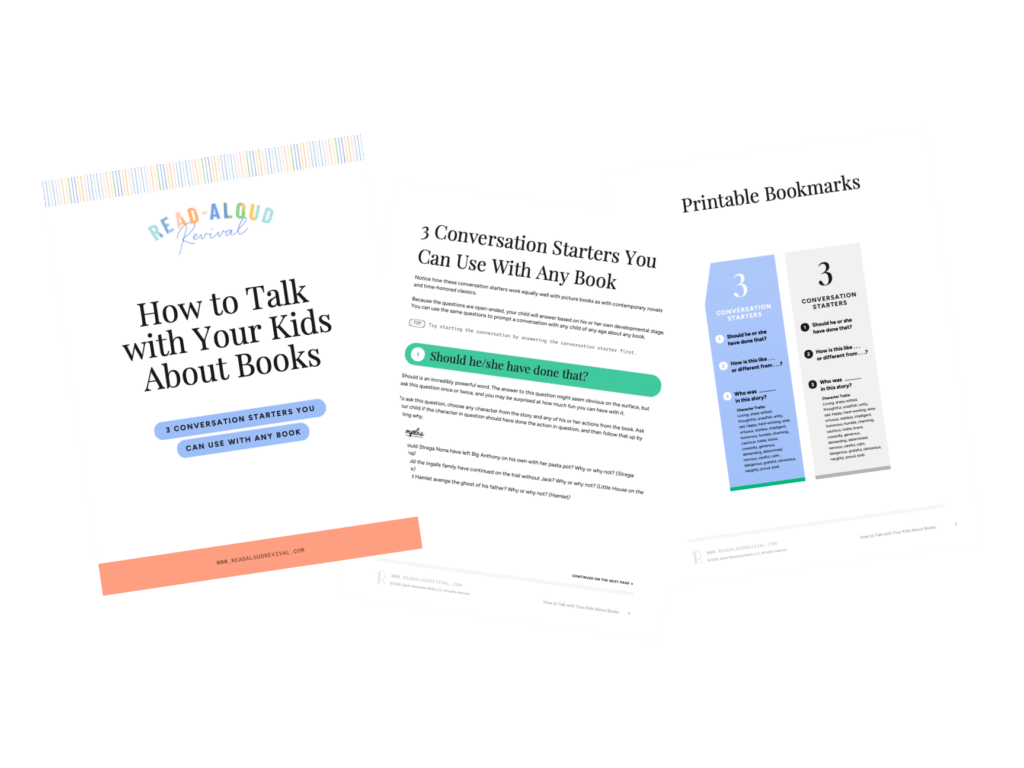
What we did, actually, at Read-Aloud Revival is we have developed a free resource for families that will help them have these conversations about books and ideas, movies, shows, songs. It can be any kind, any form, of storytelling, actually.
(17:28):
How do you ask questions and engage in a conversation that’s not a quiz but is actually an invitation to a real conversation and then trusting that those conversations, even though you’re writing nothing down, necessarily, are actually the bedrock of good writing? Because like you said, the heart of it is actually wonder, learning to ask questions, to think about ideas or books or characters or places and things in history from a different perspective. There’s a few conversation starters that work for almost any book which is why it’s super useful to have this resource will give you … A good example of this is, “Should he or she have done that?”
(18:13):
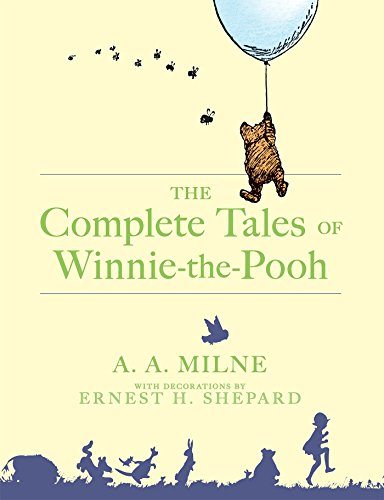
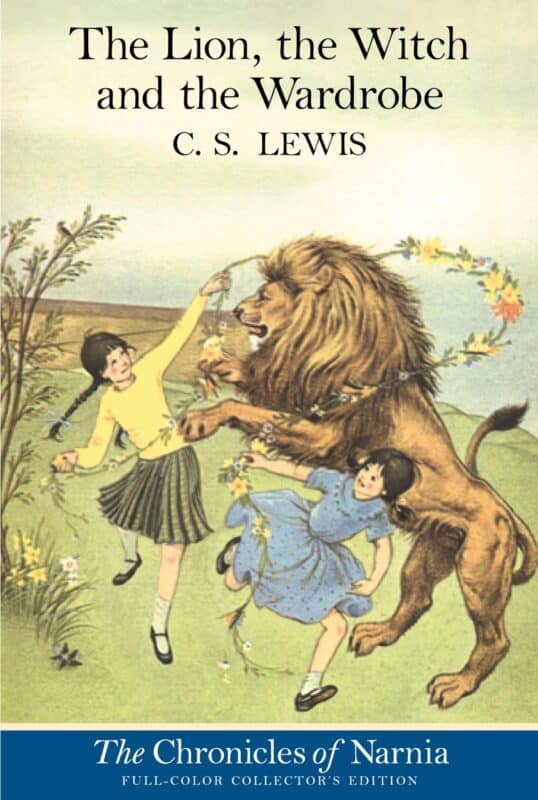
And you can ask that question about any book. I could ask it right now about Little House on the Prairie or The Lion, the Witch, and the Wardrobe or Winnie The Pooh or that football game where we just watched that player do that. Should he have done that? Or the movie where should the girl have run away? I mean, we could just keep going. Should he or she have done that is a fabulous question that has no necessarily right or wrong answer, but it’s a real great conversation starter. And these kinds of conversations, I feel like they don’t count because they are … We feel like they don’t count because they’re not hard, and they don’t … We’re not writing anything down, so it sort of feels like, does this actually count as writing? But I feel like they’re the most important thing we do to actually teach our kids to write. Because when you write, absolutely, they start with wonder.
Audrey Menck (18:59):
I just love this resource because it’s not those yes-or-no questions. Because actually, if you were to give your kid a quiz full of yes-or-no questions, I would say that almost seems to be less effective in the long run as far as making those connections because it’s these open-ended questions that foster a sense of wonder and help us to engage with ideas and thoughts and make connections we aren’t able to with a more straightforward yes-or-no, black-or-white answer.
Sarah Mackenzie (19:24):
That’s so great. And actually, I think, too, it also trains us to ask good questions. Then when we’re reading, our kids are going to do most of their reading … God willing, they’ll do most of their reading after they leave our home. They’re only in our home for the first less than two decades of their life. Then if they’re used to asking questions as they read, we’re giving them the tools to be discerning readers and to have the skills of writing as they’re reading and thinking about things going on.
(19:49):
But anyway, we’ll put that resource. That’s a free resource that we’ll put in the show notes. You can also just text the word conversation to the number 33777, and we’ll just automatically send it to you. Like I said, you can use it to talk about any stories. Any books, any movies, any sports games, those are also stories. We should probably talk about that on the podcast sometime. A play that you’ve seen. Of course, my favorite way to use it is with books and not just books that you’ve read together, but I used the questions and the conversation starters quite often with all of you six Kids with books that I haven’t read.
(20:28):
Actually, sometimes I think those are better conversations because you really know that I don’t know. I’m not looking for a particular answer because I haven’t read the book. I’m just really curious. Who was the most cowardly in that book? What did they do? Who was the most courageous in that story? What did they do? And I don’t have that answer. It’s just this real great invitation story. You can use that resource with any book which makes it really useful whether your kids are four or 14 or 24. It’s a really handy resource.
(20:53):
You just text the word conversation to the number 33777, or you can go to the show notes for this episode. It’ll be there too.
Audrey Menck (21:00):
Absolutely. I think sometimes these kinds of recommendations like, “Wonder more with your kids. Cultivate a sense of wonder about the world,” can feel so widely like, what does that even really mean? How do I do that? We really hope this resource is a tangible help to you. And it’s really a resource for all families because having these conversations and cultivating wonder and the love of story and storytelling is really something that is in every parent’s wheelhouse, no matter where your kids go to school.
Sarah Mackenzie (21:24):
That reminds me, actually, just a few days ago, I came across this mural. You and I were looking at it, actually, together. It’s a mural of Flora Lewis, who’s the mother of CS Lewis, author of Narnia and all the best books. The Screwtape Letters. One of the best Christian thinkers and writers, right? And this image I had never actually thought … I mean, this sounds terrible, but I haven’t really spent a lot of time thinking about Lewis’s mother, actually. But CS Lewis himself credited his imagination to his mother. And this mural is Flora’s face and her head. There is just floral joy, flowers and plants and life, coming out of her head. And it’s such a gorgeous depiction, I think, of … CS Lewis believed that his imagination was a gift from his mother. I can just picture this beautiful mother instilling this love of story and words in little Jack’s … Just this little CS Lewis, who went by Jack as a child. And him realizing that that love of story came from his mother’s imagination.
(22:45):
And it just reminds me that it feels like laundry and dinner and driving kids back and forth to activities and reading aloud and getting some of those things in, but it doesn’t always feel like we’re handing our kids the power of imagination, but that’s actually what we’re doing. When we allow them time to engage with stories on their own, we read stories with them and talk about them, wonder with them.
Audrey Menck (23:07):
And just what a testament to the fact that those little things one step at a time just add up. Because Flora actually passed away when CS Lewis was only 10. They only had 10 years together, but it’s just absolutely undeniable when you look at his life and you look at how many people he’s touched just to think of that, that storyteller in her that imparted that into him and then changed the world.
Sarah Mackenzie (23:30):
Well, it’s fun to hear you talk, too, about the reading aloud and then wondering, just having time and space to ask questions, and wonder being so formative to writing because I think what most of us think is that there’s a particular curriculum or a certain method that we should be using to teach our kids the actual form of writing that has the biggest impact. And those things are useful because writing in a certain form, learning how to write an essay compared to a story compared to a letter, is important, but that there’s something else that you’re already doing and you can do today without buying a thing. It is reading aloud and talking with your kids about the ideas that are coming up there and wondering with them that is the most useful.
(24:11):
I hope it gives all of our listeners like, “I’m already doing something. I’m already really good at that,” or, “I have a way to get even better at it that’s … This is simple. I can do this.”
(24:22):
The benefit, I think, is the mother. Is that alongside just enjoying the book and talking with your kids about it, that’s actually the same thing that you do to strengthen your relationship with them. At the same time you’re giving your kids these powerful tools of writing, you’re nurturing these relationships that are going to carry you forever. It’s actually fabulous. It just really is.
Audrey Menck (24:42):
And before we go, I just want to add one more thing too. I think oftentimes we want a formula. I mean, I know I do. We want to guarantee that our efforts are going to result in a certain thing, that if we ask good questions, our kids will become good writers. If we study for this degree, then we’re going to get this exact job. Or if we take this trip, it’s going to go a certain way. We’re not going to miss a train or a bus or get turned around, but we’re just not able to guarantee life like that. I remember being about to graduate from undergrad, and I was on a mission trip in the South Bronx in New York City, and I was standing on the fire escape of the friary that we were staying at. And I was just so overwhelmed by all the life choices that laid before me. I didn’t know what to do or where to go.
(25:24):
And I just had such a sense of God’s promise, of Christ’s promise, to his apostles in Matthew 28:20 when he says, “I’m with you always to the end of the age.” And I just knew he is going to be with me. No matter what decision I make, no matter where I go, the spirit of God lives and dwells within me. And I’m quite confident that Flora Lewis had no idea what those tiny moments of being a mother, especially … I mean, think about 10 years old. Most of their time together was just her caring for his physical needs probably, but I think it just comes back to what you always say of you just have to bring your basket. You have to give the Lord what you have which might be simple and small. It might just be questions and a trip to the grocery store, but you let him feed the 5,000. You let him turn water into wine. You let him work the miracle.
Sarah Mackenzie (26:13):
So true. And it’s true. He’s the author of our children. He’s the author of our relationships. He’s the author of wonder. Our kids are made in his image and likeness. And so often I think it’s easy as mothers for us to think of our kids, our homes, as projects, like this is something that we have to shape and fix and change. And we do shape it but not usually by fixing it. Usually by being little lighthouses, being beacons of light, that point our kids toward wonder, point our kids toward the ideas that they encounter in books, making reading something that we just do in our home and is enjoyable so that they want to do it more, and then having conversations about books or just what happened in their day. A normal, expected, warm thing. And when we do that, we’re able to be his hands and feet. We’re able to point our kids toward wonder.
(27:07):
And it does a lot for our relationships. It does a lot for what will carry them like when you were standing on those steps. We never know the things that we’re either planting or not that are going to be there right when our kids need it most. As a mother, I think one of the things I’m usually the most worried about is, what if I don’t give my kids something they need? But when we invite them into stories and conversations and remind them who they are and whose they are, we’re bringing our basket, and he is working that miracle. He’s doing the hard work, and we can rest in that.
Audrey Menck (27:35):
And he’ll provide everything we need.
Sarah Mackenzie (27:37):
That’s right. Thank you so much for coming back on the show. I think we’re going to have to do it more often, especially now that you’re living back close by. That’s going to be so fun. Where can our listeners find you? And I will also remind listeners that we’ll drop a few things in the show notes. We’re going to drop that mural of Flora Lewis so you can see it for yourself. I think you’ll be inspired by it. The resource for having conversations with your kids about stories and ideas and also a link to your newsletter, but where else can they find you online?
Audrey Menck (28:09):
Yes, you can find me at my blog, and my writing is there. Just audreymenck.com, M-E-N-C-K.
Sarah Mackenzie (28:16):
Awesome.
(28:22):
Well, let’s go listen to see what the kids at Read-Aloud Revival have been reading and loving lately.
Aniston (28:32):
Hi, my name’s Aniston. I’m eight years old, and I live in Noblesville, Indiana. And I recommend The Green Ember because it’s about rabbits, and I think that rabbits are really cute. And the rabbits talk. And they go on a really good adventure. And then they go to some kind of really cool house.
Speaker 4 (28:57):
What’s your name?
Kennedy (28:57):
Kennedy.
Speaker 4 (28:57):
And where are you from?
Kennedy (28:57):
[inaudible 00:29:02].
Speaker 4 (28:57):
Where?
Kennedy (28:57):
South Carolina.
Speaker 4 (28:57):
What’s your favorite book?
Kennedy (28:57):
[inaudible 00:29:10].
Nora (29:12):
Hi, I am Nora. I am nine years old. I live in Guilford, Indiana. I recommend Harry Potter and the Sorcerer’s Stone because I like the owl, Hedwig, who delivers mail to Harry Potter.
Emmett (29:28):
My name is Emmett. I’m from Texas. And my favorite book is Dragon Masters. And I like Dragon Masters because I like the dragons and the people.
Sarah Mackenzie (29:44):
What’s your name?
Charlotte (29:46):
Charlotte Balakia.
Sarah Mackenzie (29:49):
Very good. And how old are you?
Charlotte (29:51):
Three.
Sarah Mackenzie (29:54):
And what’s your favorite book?
Charlotte (29:57):
George.
Sarah Mackenzie (29:58):
Curious George?
Charlotte (30:00):
Curious George.
Sarah Mackenzie (30:02):
What’s your favorite part?
Charlotte (30:04):
Flying on the balloon fleet.
Sarah Mackenzie (30:05):
On the balloons. That’s a fun part.
Levi (30:11):
Hi, my name is Levi, and I’m six years old, and I live in Noblesville, Indiana. And this is where I recommend The Penderwicks. It’s a good book, and it’s a good summer book to read.
Audrey Menck (30:27):
What’s your name?
Josie (30:29):
Josie.
Audrey Menck (30:30):
And how old are you?
Josie (30:31):
Four.
Audrey Menck (30:31):
And where do you live?
Josie (30:31):
In Noblesville, Indiana.
Audrey Menck (30:35):
And what book do you recommend?
Josie (30:36):
A Uni’s Treasure.
Audrey Menck (30:39):
And why do you like it?
Josie (30:43):
Because it has so many treasures. And I really like it because …
Audrey Menck (30:49):
It’s great.
Sarah Mackenzie (30:52):
Thank you so much, kids. You know I love hearing your book recommendations. Show notes for today include all the stuff Audrey and I talked about. Go check those out. You can find those just in the link in your podcast that you’re listening to right now. You can also go to readaloudrevival.com/subscribe if you’d like to get those monthly From Sarah’s Desk newsletters. I am reflecting a lot on the homeschooling that I’ve done with my oldest kids, who are 24, 22, and 20, as well as my younger kids who I’m still homeschooling and thinking just about what we’re really doing here and what makes the biggest impact in the conversations I have with homeschooling moms all over the country. I’d love for you to subscribe to that. Readaloudrevival.com/subscribe. And of course, I’ll be back in two weeks with another episode. But in the meantime, you know what to do. Go make meaningful and lasting connections with your kids through books.