RAR #284: Finding Rest in the Mess (Circle With Sarah Sneak Peek)
How long is your to-do list?
What if you added in all the extra shoulds and supposed-tos that you are in your head but you don’t even write down because that would be too overwhelming? How long is it then?
It might feel a little cliché to talk about how busy we are. But I think it’s helpful to acknowledge that most of us are at least a little bit (or more) fried.
So why do we do this to ourselves? Why do we keep piling things onto our to-do lists?
If you take a closer look at your list, I think you’ll find that underneath that busyness, the reason is relationships. Your list is long because you love your kids, and you want them to feel loved and supported by the things you do for them, from teaching to cooking to cleaning to working outside the home.
But a hard truth I’ve learned in nearly 25 (!!) years of motherhood is that restless busyness can make it harder to do the things that actually allow us to nurture our kids, develop fruitful relationships with them, and model God’s love.
Today on the show, I want to help you find some rest in the mess so you can show up in all of your relationships with more peace and even, dare I say it… joy.
To do that, I’m going to let you in on some of our favorite moments from Circle With Sarah over the last year. Circle With Sarah is one of our Read-Aloud Revival Premium members’ favorite features. It’s a private podcast, live virtual events, and biannual virtual retreats all designed to support you in the journey you’ve chosen as a mom.
In this episode, you’ll hear:
- Shifting your focus to how far you’ve come from how far you have left to go
- A simple exercise for getting to the root of worry and learning to trust that what we do is enough
- Tips for reframing interruptions, prioritizing rest and connection
Some links are affiliate links
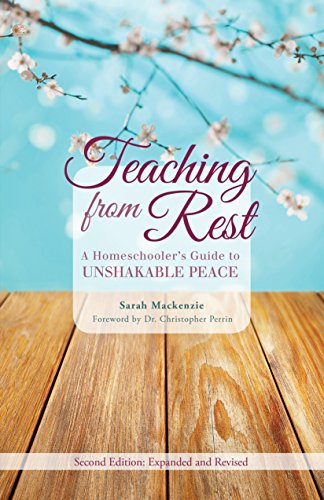
Books and Resources Mentioned in This Episode:
Sarah Mackenzie (00:00):
How long is your to-do list today? And if you added in all the extra shoulds and supposed tos that you don't dare put on the list because it would be even more overwhelming than it already is, how long would it be then? I know, I know. It's a bit cliche to talk about how busy we all are, but I find it helps to acknowledge that most of us are a bit or more fried. So why do we pile our to-do lists so full? Why do we subject ourselves to those extra shoulds and supposed tos? Well, I think if you took a close look at your list, you'd see that the reason is a good one. The reason is relationships. Your list is as long as it is because you love your kids and you want them to feel loved, to feel supported by the work you do for them, whether that's teaching, cooking, cleaning, or a job outside the home, whether it's running them to soccer practice or taking them to choir.
(01:07):
But here's what I've learned in nearly 25 years of motherhood. Restless busyness might seem like an effective tactic for strengthening your relationships, but it is not a solid long-term strategy. Restless busyness often makes it that much harder to do the things that actually allow us to nurture our kids, to develop fruitful relationships with them and to model God's love for them.
(01:51):
Welcome to the Read-Aloud Revival Podcast. This is the show that helps you build lasting relationships with your kids through books. I'm your host, Sarah Mackenzie. I'm a homeschooling mom of six and the author of The Read-Aloud Family and Teaching from Rest. Today on the show, I want to help you find some rest in the chaos, in the mess, in the dailiness, so you can show up in all of your relationships with more peace and, dare I say, joy. To do that, I am going to let you in on some of our favorite moments from Circle with Sarah over the last year. Now, Circle with Sarah is one of our Read-Aloud Revival members' favorite features inside RAR Premium. It is a private podcast. It's regular live virtual events and it's a mama book club that all serve to help us become the peace-filled, joyful moms we're called to be.
(02:49):
So let's get into it.
(02:58):
Now rest and peace are two sides of a very valuable coin. It's hard to truly rest when things feel chaotic and it's hard to find peace when you're burning the proverbial candle at both ends. So let's define some terms here, shall we? By rest, I mean physical rest, of course. Sleep, relaxation, sometime to recharge, right? But I also mean rest for your mind and your heart. A chance to narrow your focus and just quiet the clamor, the noise that is constantly happening in your head, at least there's noise that's oftentimes happening in mine. That's what I mean by rest. And by peace, I mean an internal stillness, that calm fortitude that comes from our connection to God. Peace doesn't mean that everything is going according to plan. It means that we are tethered to the steadfast love of God no matter what storm is actually happening around us. I'm talking of course about the peace that transcends all understanding that we are promised in scripture.
(04:11):
Now along with rest and peace, we also need a sense of enough because one of the things that robs us of both peace and rest is feeling like we're not enough and that we're not doing enough. It might feel like not enough is a perfectly natural way to feel and that it's perfectly natural to trade rest and peace for trying to be a little more enough. But here's the truth. We are not enough. We don't need to be. He has never asked us to be enough for our children. That is not what he's asking us. We aren't enough because he is. It's just like he said, my power is made perfect in your weakness. That's in 2 Corinthians. But really the message that we're not enough and we should be is kind of everywhere, right? Especially on those little comparison machines we check multiple times a day. You know the one, right? The one that goes with you everywhere. You might sleep next to it. Keep it in your pocket that you check more often than you want to admit. So do I, by the way.
(05:19):
If we want to reclaim peace and rest, we need to get a handle on comparing ourselves to others and to our own expectations. So in this first clip from our February 2026 Circle with Sarah virtual retreat, our community manager, Kelsey Murphy and I discuss how comparison triggers that feeling of not enough. And we also talk about a simple way to reframe how we measure what we've done.
(05:53):
So here's how I know these are some different things that might come up for you as well that show up as avoiding comparison is an area we want to work on. Feeling like you're not enough, that you're not doing enough or that you are not enough. That not enough-ness feeling, whether it's about what you do or who you are or what your kids can do is oftentimes direct correlation to comparison. Doom scrolling. You know what that is, right?
Kelsey Murphy (06:22):
No.
Sarah Mackenzie (06:22):
When you are like, it can be on any social media platform, it can be Instagram, it can be Facebook, it can be YouTube, it can be anything, it can just be online, where you are looking at things and if you were to stop ... So this is how I know I'm doom scrolling, you guys, is if I can go like, "If I stopped right now and put my phone down, would I leave feeling encouraged and hopeful?" And if the answer is no, I'm doom scrolling. So this can be a little different. I know it's tricky. Sometimes we say, "I can't read the news because I can't fix all of those issues. They're outside of my control. And then I feel guilty that I'm not ... " So, today let's just keep this really focused on any kind of content that you interact with online that's related to mothering, parenting, homeschooling, or homemaking, any of those things. If you are looking at things and they're making you feel less hopeful or less encouraged, if I was to put down my phone and look at my actual life and feel better about them, then that's different, that's not doom scrolling. That's just not usually what happens for me.
(07:28):
A lack of confidence in your schedule, your family's activities, anything that you've chosen for your kids. Is this enough? It kind of goes back to that enough-ness thing. If you're feeling anxious that your kids aren't where they should be or where someone else's child is, where the public schools are, what they're learning either in your neighbor's kids, your sister's kids, the other kids in your homeschool co-op, a comment that somebody says to you about what your kids do or don't know. If you're feeling anxious that your kids aren't where you think they should be, then avoiding comparison is an area to focus on.
(08:06):
We talk about that pitfall of the composite woman. In today's day and age, what we do is we look at our social media feeds and we see one woman who is reading aloud all these amazing books to her kids and then another who's doing nature walks and maybe even leads a nature club. And then another one who's taking her kids, they're road schooling, let's say. They're traveling to all over the place and giving their kids real experiences there. Somebody else is homesteading and grinding their own grain or everybody has chickens.
(08:41):
It's like this whole ... And we take these one little pieces from all these different women and in our head, we combine them into one fictional composite woman and we hold ourselves against her and we can never win. There is never any possibility that we can measure up. And so it's that pitfall of when we start imagining that everybody else is doing it better than we are. We have a tendency to be like, "Okay, I want my kids to X," whatever that X is. So reading at a certain level or being able to do a certain thing. We have this idealistic version of what we want our kids to be able to do or what we want ourselves to be able to do in our homeschool. And then we're constantly measuring the distance between where we are and where we want them to be. So all we're doing is focusing on the lack over and over and over again. We're focusing on our deficiencies.
(09:26):
And instead, if we were just to go like, can we just look at where we came from and where we are now? And then you're focusing on the growth, it just changes everything. So that helps us then focus more on our progress rather than perfection or our gains rather than where we're constantly falling short. And then I also think what can be helpful here when we're trying to avoid comparison is remembering that God is not disappointed in us. And I really feel like when we did this, we talked about God being not disappointed in us at some Circle with Sarah Lives earlier, and there are some Circle with Sarah podcasts on this if this resonates with you. But I think this is something that most of us struggle with is feeling that God must be disappointed. He must have thought He wanted us here and here's where I am and he's on this lack. He's wondering why I can't ...
(10:18):
No, God is not surprised. He called you to this knowing exactly your weaknesses, knowing exactly what was going to happen, knowing exactly where your kids were going to be. None of this is a surprise to him. He's still called you to this, and he loves you and is not disappointed in you. And so this is a real place where if this is an area for you that feels like a difficult struggle, this avoiding comparison, where really getting hold of that truth that God is not disappointed in you can be transformative for you.
(10:48):
Ah. Measuring your progress from where you started to where you are now, rather than measuring the distance between where you are now and where you think you're supposed to be really can open the door to peace and rest. And when it comes to understanding what's enough, what we're actually being asked to do, I often return to the story of Jesus feeding the 5,000. It reminds me that my job is not to guarantee results. It is not my responsibility to feed everyone on the hillside. My job is to bring my basket. Now in this clip from our August 2025 Circle with Sarah Retreat, Kelsey and I discussed this story of feeding the 5,000 and what it means to bring your basket no matter how small you're offering.
(11:49):
I love this episode on The Chosen, on that depiction of this particular story too, because it gives you a sense of just how many people. I mean, there weren't 5,000 people in that video shoot. And so even knowing it was more than this even. There's so many people. And also the complete feeling of helplessness that the disciples must have had. Does Jesus realize they're going to get hungry? And I don't know about you, but that's kind of how I feel at the beginning of a new homeschool year too, does Jesus realize I don't know what I'm doing? Does he realize there's not enough of me to go around?
(12:25):
And what I love so much is there's a couple things the Lord could have done. The Lord could have made everybody just be instantly full so there was no conflict, no problem in the first place, but he doesn't do that. He also doesn't just make a grand feast instantly arrive or even mana fall from the heavens. None of that actually, which he could have done.
Kelsey Murphy (12:44):
Which he could have. Yeah.
Sarah Mackenzie (12:45):
Yeah. And it actually would've probably been more impressive than what he did, which was, "Hey, bring me what you have." And they're like, "Yeah, not much, Lord."
Kelsey Murphy (12:55):
It's not enough.
Sarah Mackenzie (12:57):
Which is exactly how we feel. And he makes it enough. And that's what he's asking every single day in our homeschool. And we wake up and we go, "Are you sure, Lord? Because I don't think I have what I need here." He's saying, "Bring me what you have and I'll make it enough." He's not saying, "I'm going to make everybody instantly satisfied so there's no conflict and no problems." He's not even saying, "I'm going to completely calm the storm today." He's saying, "I'm going to take what you have. I'm going to make it enough so that you are not actually responsible for the miracle." What we're responsible for doing is responding to that invitation, "Bring your basket. Show me what you have. I'm going to take what you have."
(13:36):
I'm just curious as I'm saying that, and I know so many of you have heard, we've talked about this story all the time, but I really feel like this is the story of motherhood, of homeschooling motherhood. When you hear that, when you hear you are not responsible for the miracle, you're responsible for responding to the invitation. How do you feel? What does that do inside of you? How does it change the way you think or feel? Elizabeth says, "It brings peace and hope, relieved. It makes me take a breath."
Kelsey Murphy (14:02):
Really.
Sarah Mackenzie (14:02):
Yeah. That feels like I can breathe. "My shoulders went down," Adrian said.
Kelsey Murphy (14:06):
Yeah.
Sarah Mackenzie (14:07):
Yeah. Sigh, a weight off my shoulders. Relieved and relaxed. Yeah. Amanda says, "I literally feel like a huge weight is lifted."
Kelsey Murphy (14:18):
It's hard because we know these things, but the fear still creeps in. The fear that we're not doing enough, that we're not offering enough, that our kids are not getting enough far enough in school where they need to be. And really fear is the antithesis of peace.
Sarah Mackenzie (14:39):
That's right.
Kelsey Murphy (14:39):
Fear really robs us of peace. And it's hard because our worries about homeschool and our kids, they come from a desire to see our children succeed. And I think they come from ... Well, I don't think fear comes from a good place, but it comes from-
Sarah Mackenzie (14:57):
An honest place.
Kelsey Murphy (14:59):
... a want. Yeah, to do well, to love the Lord even. But we're too focused on the outcome like you were talking about instead of the invitation. We forget to remain with the Lord peacefully before the gaze of God, he says, where we can soak in his wisdom and power because we're too busy trying to do everything on our own. The reality is there's going to be setbacks. There's going to be things that come up that we are not prepared for. There's going to be suffering. There's going to be things out of our control. But our goal is not to try to control all of those things and control the outcomes. Our goal is to maintain a piece of heart under all of those circumstances, even in the case of defeat and failure and whatever that looks like in your own life.
Sarah Mackenzie (15:53):
I see in the chat, I feel the relief, but can almost immediately go back to, "But am I bringing enough for him to work with? Am I faithfully bringing enough?" And I just think I totally feel that same feeling and also they didn't bring enough. They had a child's basket of loaves and fish. The whole point is that it wasn't enough. It's interesting because we do really have to take it on faith. It's easier to do when you have a couple that have gone up through. I mean, I can look at all my kids now that are my three adult kids and go like, oh, there are whole subjects I never got around to teaching. There were a couple years in there where we did very little school at all because we had so many babies and I was so overwhelmed and I felt like I was constantly underwater. And I can guarantee you it was not enough. I was not bringing God enough to work with and yet he still makes it enough.
(16:39):
One of the sentences that I find really helpful here to shift my thinking, because it's almost impossible to get to this head space when your brain starts going with all the ways that you're not enough and that you're failing because you feel like you're failing. This sentence can be really useful for me. I think about the thing I'm worried about. So I'm just going to pick something random just for the sake of an example. My kid's not reading, because I bet there's a good number of us here tonight that would say that's true. My kid's not reading and they're supposed to be reading. So I'm worried about this because I'm worried about my child not being a reader yet because... And then just why? Finish that sentence. Instead of letting your brain stop at like, I'm worried about my kid not reading. Yeah, it's like you're drowning and that's it. That's just all there is to it.
(17:31):
So make yourself finish the sentence. I'm worried about my child not reading because. And when you finish that sentence, it usually almost always gets finished with a fear. It makes it really blatantly obvious that the thing that you're worried about is fear. I'm worried about this because I'm afraid my child won't get into college. I'm worried about this because I worry that she'll get behind. I'm worried about this because I'm worried my mother-in-law or my mom won't think I'm doing a good enough job homeschooling. I'm worried about having a new baby this year because I don't know how I'll manage another baby when I'm already so overwhelmed. And then what we realize is that thing that you finish with the because, it's almost always fear.
(18:15):
And we know that fear does not come from Christ. So that's how we can go, oh wait a second, that's right. This though of I'm worried that any of those things is actually not from God because when you finish it's pretty much always embedded in fear. It's rooted in fear, I guess. I'm worried about blank because, blank. This simple exercise can help us see the fear at the root of our worries, the fear that makes it hard for us to rest, the fear that makes it hard for us to experience the peace that transcends all understanding. And once we can name that fear, we can bring it to God. We can bring him our basket and he will make it enough. Now in that same retreat, Kelsey and I talked about how maintaining peace and finding rest is especially difficult in the midst of all those interruptions. And none other than C.S. Lewis has some wisdom for us on that. You know how much we love the wisdom of C.S. Lewis.
Kelsey Murphy (19:25):
Obviously there's things that we have to get done and there are things that steal that peace. And one of them I think are what we consider interruptions in our ideal life.
Sarah Mackenzie (19:38):
Everything. Everything feels like an interruption.
Kelsey Murphy (19:40):
Everything feels like an interruption. We're making headway in the math lesson and the baby needs their diaper change or there's a blowout or something. Or you have a full day plan, it's going to be great and someone is up puking the night before. These things happen. And I'm going to quote C.S. Lewis because I love this so much, "The great thing, if one can, is to stop regarding all the unpleasant things as interruptions of one's own life or real life. The truth is of course that what one calls the interruptions are precisely one's real life. The life God is sending on day by day."
(20:20):
I know I get too hung up on my ideal life and my ideal day. And so when there is something that does not fit in my box of ideal, such as children puking all night, I'm very quickly agitated and angry and discouraged and just want to pull my hair out. But the fact is I can't control or live in that ideal. And God gives us grace for reality. This is something you say all the time, Sarah. God gives us grace for reality for our real life, not for our ideal life, for our real life that we have to live every single day.
(21:05):
And something that is very comforting to me is that nothing is a surprise to our God, even though things come at us and it's surprising and shocking all of the time. He's not thrown by this. Nothing is a surprise to him. Nothing happens outside of his will. And I know it feels like those difficult times are interruptions and they're hard. They're some hard things, but God is not thrown by that. And we can trust that he is working even when we're running around trying to figure out what is going on.
Sarah Mackenzie (21:47):
It's true. I love to look up what an actual word means. So as I was thinking about this idea that Lewis shares about how there's not really any such thing as an interruption because you do only get grace for your reality. Everything we're worried about is future. Everything's in the future. So the past is behind us, but the future is really easy to worry about because it's a fiction. It doesn't exist yet. We've imagined what it's going to be like and then we're worrying about it, but it's really easy to worry about the future because it's fiction. This is why I think it's so helpful. If you have all younger kids, I remember when all of my kids were 12 and under, six kids 12 and under, and it felt like, how will I ever homeschool high school? That's going to be impossible because I can't barely handle what I have right now. And you're like, right, you're not being asked to homeschool high school right now. You don't have the grace to homeschool high school right now because that is a future.
(22:36):
So I'm worrying about it and taking things on. That whole worrying about tomorrow today has enough problems of itself. We know all of this is true. So if we looked up what an interruption actually is, the word interrupt actually is defined as to stop the continuous process of something. So in your mind, using Kelsey's example, you're making some progress on a math lesson and then the baby needs to have her diaper changed. And then by the time you maybe change the baby's diaper and then you come back, that kid who was doing math is now making paper airplanes and pelting his other sister and she's shrieking. And then the other kid who was doing his schoolwork in the next room is yelling that he can't hear himself think because of all the noise. And you're like, oh my gosh, we were doing fine. We were making good headway until this interruption.
(23:25):
But an interruption is stopping the continuous process of something. So sure, it was stopping the continuous process of math, but we know what we're charged with, to love God with all of our hearts and all of our souls and all of our minds and to love others as ourselves. Everything comes second to that. Your math, your crock pot plans, going to the dentist, going to co-op, everything obviously. The most important thing we do is love God with all of our hearts, souls and minds and love others as ourselves. And therefore the baby needing a diaper change in the middle of a pretty good lesson that you're making progress on isn't actually interruption. It's not stopping the continuous process of you loving the Lord with all your heart, soul, and mind or loving your children as yourself.
(24:07):
The dog throwing up and you having to go clean it up or a solicitor coming to the door, even though you have a sign that says no solicitors, just saying. They're stopping the less important thing. Sure, it's stopping the continuous flow of math. But the more important thing, the loving God with all of our heart, souls and minds, the loving each other as ourselves, it's not stopping that. In fact, most of the time those interactions are an opportunity to do exactly that, more. To love others and to love God more. And so in that case, there is absolutely no such thing as an interruption when it comes to loving God with all our heart, soul, and mind and loving others as ourselves, which is our priority. I think that's what Lewis is basically saying when he says there's no such thing as an interruption. He's saying not to the most important things. Maybe to the things, like Kelsey said, that you have a plan. You like, this is how this day is going to go, but we don't know actually. God does know. Nothing's a surprise to him. So it's not really technically an interruption because this day was always going to go this way.
(25:08):
One of the pieces that I think is really important as we start talking about guilt too, and I though about this on just this morning as I was thinking about this, was the things that you don't have peace about. Is it possible that you feel guilty because you feel like these things you should have already taken responsibility? You should have already fixed these. So you feel guilty because the reason you don't have peace about these things is because you feel like I should have fixed this by now. I was thinking about this this morning and I was like, why do we feel guilty? Especially if we think, oh, let's just go back to that Jesus feeding the 5,000 that we talked about. The thing the Lord's asking us to do is not to be responsible for the miracle. It's not actually the outcome. He's asking us to bring what we have so he can make it enough.
(25:48):
Which means that all of these things that are on your particular list of things you don't have peace about, you are being invited to just bring what you have, do your best, but you are actually not responsible for solving these problems. That's not your responsibility because you were not responsible for the miracle or the outcome. And most of the time, if you look at the things that we're most worried about, they're outside of our scope of being able to fix it anyway. If you're worried about whether or not your child's going to hold onto their faith, that is not something that you can do. There are things you can do to help them hold onto their faith. That's your bringing your basket. But the outcome of them holding onto their faith is the miracle the Lord is doing. He's never actually asked us to get perfect results. He's asked us to bring what we have.
(26:34):
So the fact that we even have guilt means that we're taking on the responsibility of things that were never our responsibility in the first place, which are the outcomes. Not that these things don't need our time and attention. We can write these things down and go, okay, how do I bring my basket in this circumstance? And this is what goes back to that, how do I respond to that invitation? Because we could say no. I mean, if we go back to that Jesus feeding the 5,000 on the hillside, when the Lord said, "Bring me what you have," they could have been like, "No, just feed these people."
(27:03):
I actually think it's funny to consider that there's this throng of 5,000 people. Disciples are like, "They're getting hungry, there's going to be riots. Send them away." I bet, I mean, I don't know, I would bet that the women there were like, "We should have brought enough food for all these people." Not like the job would be to send them away, but I should have thought of this and fixed it already. In my homeschool I feel like when I see this, I'm like, "I should have handled this." All of these things I don't have peace about. I feel guilty because I think I was supposed to fix them, but that was actually never the order. So we're actually feeling guilty because we're taking on responsibility that's not ours.
(27:43):
What are you trying to take responsibility for that's not yours? I bet there's more than one thing. What are you taking responsibility for that's not yours? What outcomes are you trying to wrestle into reality? Taking on the responsibility of things that we can't control is a surefire way to keep ourselves from getting the rest we need and the peace that we're promised. Okay. So what does that look like in practice? Well, maintaining peace and prioritizing rest doesn't just happen. A little planning can go a long way. And while I have lots of tips for planning, or as the case may be not planning, a few of my favorites fall under this umbrella of thinking seasonally.
(28:39):
Thinking seasonally can take a few different forms. You might actually think with the literal seasons. Spring, summer, fall, winter. You might think in terms of seasons of life, your own, or maybe your children's, or you might think in terms of the seasons that tend to naturally emerge from the school year, back to school energy, Advent and Christmas time, the winter, the dark winter, the stretch in the late spring when you need to keep going, but boy, does summer sound really good. In this clip, Kelsey and I share a few tips that go along with thinking seasonally. Mark transitions, celebrate and use just because we can days.
Kelsey Murphy (29:33):
All right. Well, I think we are headed into our last tip, which is to think seasonally because I think maintaining peace is easier when we can break up time into smaller chunks and have transitions prepared instead of just steamrolling from one thing to the next. I know this works well for me. Again, I get very overwhelmed by things that are too large. I need them broken down a little bit. And so, thinking seasonally instead of a whole entire academic year has been really helpful.
(30:06):
Now, there are certainly goals and things that I want to accomplish throughout the year. We don't have to throw that out completely. So this could be as simple as using our monthly picture book lists and every month you're taking your library books back and you're getting new books for the month just to mark the beginning of a new season. It could be having a specific playlist for that season. You could plan a field trip or an outing to celebrate or mark the end of a unit and it can go along with what you're studying or not. Maybe you finish a really difficult section in math and so you tell your kid, when we're done with this, we're going to go out and celebrate. We're going to get ice cream to mark being done.
(30:51):
And that way I think it helps my kids feel a sense of accomplishment of like, "Oh, I did something ... " Like, "I worked really hard on this and I finished it." Instead of just like, "Okay, great, you finished that yesterday." Here's your brand new pile of math.
Sarah Mackenzie (31:06):
It's like, "Good job you. Here's a bunch more work that you earned."
Kelsey Murphy (31:10):
"Good job. You're not done yet because now we're starting this chapter."
Sarah Mackenzie (31:14):
Yeah. The other thing that can be really useful on a seasonal basis is to use just because we can days, which is what we've talked about these before. My friend Sheila taught me this and it was basically like I had asked her about... I was asking her older kids when she had homeschooled three kids and I'd asked her at the end, I would ask them, sorry, they would babysit for me and the son was a math tutor for us and stuff. So I'd be like, "What was some of your favorite things you'd do when you were homeschooled?" And almost always they would mention these things that were like, "Oh, we went to the movies in the middle of the day" or, "We did frozen yogurt for dinner." Things that were not school related at all.
(31:53):
And also that I was like, "Sheila's not a super fun mom." She would be okay hearing me say that. "And so I was like, "What are all these fun things you did? This doesn't even sound like you." And she was like, "Oh, just every once in a while," they would do them not even that often. I think once a quarter she would have ... The kids wouldn't know they were coming. She would, on her schedule, plan ahead so it wasn't like she was grabbing it frantically, but she had it planned. We're going to go have a picnic in a park or we're going to have a game day or we're going to go have frozen yogurt for dinner when we're trying to maintain peace.
(32:27):
By planning a just because we can day, you are intentionally telling yourself, not just your kids, but also yourself, that connection matters most in our homeschool. Anybody can spare that time. Even if you feel like we can't, you can. I promise you can. You can spare just a little bit of time because the connection is the thing that's going to matter anyway in the long run. Whether you got to that actual math lesson or you covered that last part of that history unit, they will not remember probably, but they absolutely will remember if they're feeling connected to you.
(32:58):
Mark transitions, celebrate and use just because we can days. Each of those tips invites a bit of rest. Transitions help us take a beat. Celebrations remind us that we are making progress and just because we can days give us a chance to rest our weary minds and to enjoy our kids, which is sometimes something we forget to do when we're in the middle of things. There is so much more I'd like to share with you from our Circle with Sarah events over the last year, but in the interest of time and with a gentle reminder to join us at RAR Premium if you can, I want to end on what I believe is one of the best keys for maintaining peace and finding rest in the mess. Your relationships. Your relationships are the best filter you have for your shoulds and supposed tos.
(34:04):
Here's what I feel very confident saying, that relationships are the most important part of your homeschool. Regardless of what program or co-op or curriculum you use in your homeschool, the thing that will make a bigger difference on your child's life forever and ever is your relationships. They're relationships with you, with God and with each other, those, not in that order. But those are the relationships that matter. And so we want to make sure that everything that's in our homeschool otherwise ... Okay, let's think about the greatest commandment is to love God and to love one another. And so our whole homeschool, everything that we do in our homeschool, we want it to be supporting that loving God and loving each other. So that means that we can filter absolutely every curriculum, every lesson plan, every co-op, every extracurricular activity and say, if right now this is not helping us love God and love each other better, then it might not be a good fit for right now.
(34:57):
Now I'm not telling you what to do. I just think it's really useful to remember your purpose here because it's too high of a cost. If anything, regardless of whether it's this co-op or your math book or whatever it might be is costing you in relationships with your kids, that's a very high cost so you don't want to pay it without knowing that you are paying it. We always want to filter everything. Am I going to do this co-op or not? Am I going to use this curriculum or not? Under that filter, is this going to help us love God and love each other better? So I think it's like dealing with the facts and the people and the humans in front of you instead of an ideal, there's really no one size fits all if that helps.
(35:38):
If our relationships with our kids and with God are the filter that we need to run everything through, then one thing that will always make it through to the other side is rest. Checking one more thing off the to-do list is quite unlikely to improve your relationships, but filling your own tank will. Now I wrote Teaching from Rest because as a busy and overwhelmed mama of six, it was the book that I needed. And I fundamentally believe that rest is essential to prioritizing our relationships and nurturing our sweet, curious, if sometimes chaotic and difficult children.
(36:25):
Now unfortunately, rest is often the first thing to go when life comes at us like a pack of wild animals. And I have lost count of the number of women who have told me that they reread Teaching from Rest every single school year. Not because it's telling us things we don't know, but because we forget when life comes at us like a pack of wild animals, we need to be reminded again and again and again. In Circle with Sarah, we are focused on becoming the peace-filled joyful and yes, rested moms that we're called to be.
(37:00):
Circle with Sarah is my program that happens inside RAR Premium. So you just need to join RAR Premium to get in on it. We're knocking on the door of our annual August virtual retreat. The time is almost here. This year in 2026, it's happening August 7th and 8th and it's entirely online and recorded so you don't miss a thing even when those interruptions happen. Not that they would for you, of course. We're going to discuss what Teaching from Rest means, how to find rest in the chaos and mess and the practical ways to incorporate rest into your homeschool plans. Plus we'll answer your questions about how to manage it all with a little more peace. I really hope you'll join us for this retreat and for a whole year of Teaching from Rest and becoming the peace-filled, joyful mom you're called to be. Go to circlewithsarah.com to learn more and sign up. That's circlewithsarah.com.
(38:00):
Now let's hear from the kids about the books that they're loving lately.
Luke (38:08):
Hi, my name is Luke. I'm from Mount Vernon, Iowa and I'm five. My favorite book is Pilgrim's Progress. And why? Pilgrim's Progress. And why I like it is because it's about God. And this little bunny was called Christian and he goes to the King.
Atticus (38:46):
My name is Atticus and I'm seven and I live in Idaho. My favorite book is Indian in the Cupboard. And my favorite character is Little Bear because he's brave.
Speaker 5 (38:57):
What's your name?
Faye (38:58):
Faye.
Speaker 5 (38:59):
How old are you?
Faye (39:01):
Five.
Speaker 5 (39:02):
And where do you live?
Faye (39:03):
In Idaho.
Speaker 5 (39:04):
What book do you recommend?
Faye (39:06):
Because of Winn-Dixie.
Speaker 5 (39:08):
And why do you recommend it?
Faye (39:12):
Because it's a good book.
Speaker 7 (39:15):
What's your name?
Finn (39:17):
Finn.
Speaker 7 (39:18):
How old are you, Finn?
Finn (39:18):
Two.
Speaker 7 (39:23):
Two. And what's your favorite book?
Finn (39:24):
Otis.
Speaker 7 (39:24):
Otis, the tractor.
Finn (39:27):
Otis, the tractor
Speaker 7 (39:32):
Why do you like Otis?
Finn (39:33):
Because I like Otis.
Speaker 7 (39:35):
Do you like Otis?
Finn (39:37):
Yeah.
Penta (39:39):
Hi, Ms. Sarah. My name's Penta Layman and I live in Hiram, Georgia. My favorite book is Curious George Goes to a Chocolate Factory and puts it in boxes and he saves all the chocolate and he eats it all gone.
Sarah Mackenzie (40:05):
Thank you so very much, kids. Show notes for this episode are at readaloudrevival.com/284. That's where you'll find links to anything we talked about today. I hope you join us at Circle with Sarah, especially for our next retreat upcoming here in 2026 on August 7th and 8th. You don't want to miss it. If you want this to be a school year where you are teaching from rest, where you are becoming the peaceful, joyful mom you're called to be. Join us at the Circle with Sarah Retreat. I think you'll be glad you did. And let's see, I'll be back here in a couple of weeks with another episode. In the meantime, I'm pretty sure you know what to do. Go make meaningful and lasting connections with your kids through books.